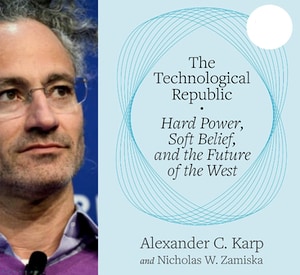
Alexander Caedmon Karp is the CEO of Palantir which he co-founded with Peter Thiel whom he met at Stanford Law School where they both earned law degrees. Alex went on to finish a doctorate in social theory from Goethe University Frankfurt, writing his thesis in German. Alex still lives in Germany half-time with New Hampshire being his U.S. residence.
He is 58, born in NYC, father a Jewish pediatrician, mother a Black American artist. In his Dealbook Summit interview, he talked about his dyslexia and I saw his restless twisting in his chair. He said he was bullied as a kid, and his writing (p. 215) jumps around.
But constructing a technological republic, a rich and thriving and raucously creative communal experiment — not merely the bacchanal of permissive egalitarianism of which Strauss warned — will require an embrace of value, virtue, and culture, the very things that the present generation was taught to abhor.
The “Hard Power” in his title is technological superiority: in Afghanistan Palantir software pulled together many data points to determine IED locations, and mapped online networks of dissidents. “Soft Belief” is his contempt for the Americans he sees as soft weenies with no strong sense of what it means to be American. He offers the Randy Travis song “Three Wooden Crosses” as an example of the American mythology he wants. The song is very emotional and tells a story of redemption over three generations.
Paradoxically, as he argues for more passion for one’s beliefs, he himself seems emotionally stunted, tribal, and bellicose. He yearns for the passion of a strong sense of country, a national sense of honor. He builds software so his team can win, and he passionately believes that the brightest minds should be making high-technology weapons, not games and shopping apps. He seems emotionally stuck at the age where he wants More Power! Hard Power! Death to the weenies!
I had not considered how unmooring it might be to be mixed. On page 202 he talks about Martin Walser, one of Germany’s leading writers and public intellectuals who suggested that the yoke of an enforced remembrance [of the holocaust] should be thrown off and abandoned — that the imposition of shame on a contemporary German public had ceased to serve any productive purpose. On page 204 Karp clarifies:
An intense skepticism of German identity, of allowing any sense of the nation to take hold in the wreckage of the war, has had significant costs and deprived the continent of a credible deterrent to Russian aggression…. Our persistent unease with broader forms of collective identity must be set aside. To abandon the hope of unity… is to abandon any real chance of survival… The future belongs to those who… fight for something singular and new.
Rebuilding this national sense of unity would (page 215 quoting Irving Kristol, 1985) “breathe new life into the older, now largely comatose, religious orthodoxies.”
I’m so grateful for thinkers like Lynne Twist who said:
There are two forces present in our world. The unawakened masculine is everywhere in our global conflicts and crises: in the military power plays; in the extraction and exploitation of our Earth environment; in an unjust and unsustainable economy; in misogyny that objectifies and harms women and girls.
But there is another force rising now as well. The awakened feminine. This is the emergence of what I call the Sophia Century, a time when the qualities long dismissed as “soft” or secondary become essential to our survival: interconnectedness, compassion, intuition, nurturing, harmony, and healing. These are not only women’s values. They are human values, and our future depends on them.
This is my “Soft Belief.” Go weenies!