Category Archives: News

Facebook Hou-Dunnie

Facebook Hou-Dunnie

Jim DeRoche posted this on Facebook with the comment, “It’s not.”

My comment:

When I was a toddler, my parents used to tie me to the highchair in the kitchen, then go to the front room to play Bridge with their friends. I was so adept at getting free, their friends called me Hou-Dunnie.

His reply:

Anyone, who is incarcerated or held against their will in any manner, possessing the mental toughness and heart to stand against their circumstances, I have great respect for always. Anyone, who adds a 3-D component to the mental one, physically demonstrating where their heart is by successfully going over the wall in any manner and beating the opposition, I have even greater respect for always! Love that move you pulled, reversing your parents sketchy binding caper, defiantly executing a move superior to that perpetrated against yourself and winning the evening. That’s a keeper of a story! ?❤️?❤️?

Yeah, well I have 10 younger siblings, and I have more stories about bound toddlers. But… another day…

Anet Dunne Crack me the F up!

Walker Creek Paddle

Walker Creek Paddle

Deb turner organized a Wednesday outing to Walker Creek which started at the Keys Creek Put-in. Justin joined us to further scout after an outing with Miguel from Marin Canoe and Paddle a few weeks earlier. A cool, 65° day was predicted but it was warm in the parking lot.
Walker Creek Put In

There was a 5′ high tide at 12:20 pm, so we put in at 10:30 am and paddled upriver with Justin who would stop and use his lopping shears to remove overhangs. At noon we hiked to the top of a hill with a magnificent overlook of the valley shadowed by the coastal mountains. The sun went behind the clouds and a breeze came up — I regretted leaving my compression shirt in the car. We took a short hike on the valley floor and saw some beautiful owls fly away. My knee-high rubber boots were adequate for the short hike.

Walker Creek Satellite Map

Red circle: estimated lunch spot

The creek is beautiful and lined with a variety of riparian trees: birch, alder, bay, and sycamore. There are many submerged logs, so a 5′ or higher tide is necessary to clear the logs and it was like paddling a slalom in many places. I think my short Kiwi boat would have been a better choice than the 14′ boat. We saw a river otter early in the trip, and as we went farther up, the water becomes very clear. When the sunlight hits the surface you can see the bright green grass growing on the bottom.
Walker Creek Map

On the return trip, we saw some ENORMOUS brown cattle with big horns at the crest of a hill where a subsidiary creek enters. We were all wondering what cattle breed we were seeing. The paddle back took one hour and the outgoing tide was clearly moving, so a shorter boat would have been fine except when transporting tree loppers as both Deb and Justin were. It takes about 45 minutes to drive from Santa Rosa to get to the put-in. This was a sensational day trip when the tides are advantageous! Very beautiful and satisfying, with a real sense of visiting a place rarely seen. I almost didn’t see it — I missed the turnoff to the Petaluma-Tomales Road twice!

Two Rock Turn Off

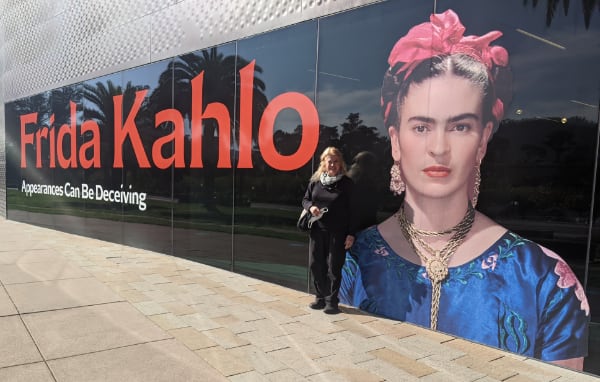
Frida Kahlo at the DeYoung

Frida Kahlo at the DeYoung

Frida Kahlo at the DeYoung

My artist friend, Sue, drove up from Santa Monica to join me for a visit. It was nice that the gallery wasn’t shoulder-to-shoulder with visitors like some previous special exhibitions. This show captures the time when women were objects — I find it useful to think of them as products of their own marketing. Examples from my youth: Jackie Kennedy, Marilyn Monroe, Maria Callas. Like Frida, each was exquisitely aware of her public persona and cultivated it carefully.

Back in Frida’s day, art was narrowly defined by the kinds of things you see in the Louvre: pastoral landscapes, allegories, myths, biblical stories, heroic battles, portraits. This show is much more personal and feminine, and I was stunned to learn that her foot had been amputated and that she died before her husband Diego who was 20 years older. I was also surprised that her father, G. Kahlo, was German-born, and that the Casa Azul belonged to her because her father had bequeathed it to her.
The photographic portraits of her were very interesting to me. Her father was a professional photographer so she knew how to “sit” for a photograph and many famous photographers (Weston, Dorothea Lange) made portraits of her. As her reliance on pain-killers increased, you can see it in her face in the images.

Her father made many photographic self-portraits of himself, and that may have influenced her many self-portrait paintings. The artist I went to the show with has NEVER done a self-portrait, and neither have I.

Of course, the clothes and the story behind the clothes was the centerpiece. I liked the show a lot.

Van Damme Camp Albion River Paddle

Van Damme Camp Albion River Paddle

Covid restlessness finally kicked in for me after seven months of seclusion. I joined Lori, Deb, and Liam for three nights camping at Van Damme State Park at the end of October. Liam and I shared site 009 and Deb and Lori were next door at 008 where they had the sunshine and free wi-fi that Lori loves. She joined a Zoom meeting with the Petaluma Paddlers one evening! This was my first visit, and not cheap! My half of the on-line reservation was $61 plus $10 a night for three nights as “extra car” for a total of $91. I discovered more private and forested campsites 27-30 deeper in the “lower loop” that are far from wi-fi and close to the Fern Canyon trail that I would like to try out when it is hot in Santa Rosa. Here is a link to a video showing all the Van Damme campsites.

Van Damme Campsite 009

Ft. Bragg Bike Trail

Wednesday Bike Ride

We all brought bikes, and Lori on her electric bike led us on a trek from the north side of the mouth of the Noyo River in Ft. Bragg to MacKerricher State Park Laguna Point for lunch. Because it is autumn, the rafts of ice plant that cling to the coastal cliffs were turning red, making russet caps on the ochre cliffs silhouetted against sea. I had not been on a bike for years, so the 11-mile ride was a stretch for me and for Deb.

Mercury is retrograde, and when we returned from the peddle, Deb’s car battery was dead (again). Liam gave her another jump start and we rolled into Mendicino Tow at 110 Manzanita St at the north end of Ft. Bragg just before closing to get a new one.

The scenery along the coastal trail was quite beautiful, with plentiful, colorfully-painted rest stops along the way (Covid petri dishes) and beautiful Glass Beach sparkling with the sea-softened remnants of a long-ago refuse site.

The next day we explored Big River at 9:30 a.m. to catch the high tide, but it was too windy so we drove south to Albion River Campground and paid the $5 per boat to launch. The river was beautiful, calm, dotted with unique houseboats. Deb and I got all the way to the “island” and explored the Lagoon on the way back.

Albion River Campground

Covid Line To Get Permit

Albion River

Beautiful Albion River

Albion River Owl Box

Owl Box Foreground, Lori in White Oru Boat, Deb in Blue Boat

Albion River Island

Deb Approaches Island Turn-Around Point

Albion River Island

Island Turn-Around Point

Albion River Kayaking

Heading Home

Mercury being retrograde, we got to see the Mendocino Tow people from Ft. Bragg again when we got back, because Deb accidentally locked her car keys in the trunk. Liam used his AAA membership for the call, and when Deb’s door was open and her key retrieved, the driver waved good-bye. Liam said, “Don’t you want my billing information?” “Nah, we have it all on file.” “See you tomorrow,” I chirped as he left. That night after fresh guacamole and white wine, we went to the beach across Hwy 1 from Van Damme.

The drive home on Hwy 128 is breathtaking through the Navarro section. Deb, Liam and I stopped to check out now-closed Paul Dimmick campground on the way back. No water, and the Navarro River is very low. The trip was great fun and I hope I beat the odds and will not get sick as a result of my adventure.

Two Hours to Van Damme

We Stayed in Site 8 and 9 near Campground Host and Visitor Center WiFi

Circled campsites 27, 28, 29, and 30 looked like the ones chosen by expert campers. They are deep in the campground, away from the WiFi and close to the very interesting Fern Canyon trail. I would like to check them out.

Drake’s Estero

Drake’s Estero
Drake's Estero

Liam, Bill, and Brian

Deb Turner led four of us on an all-day, socially-distanced paddle to Drake’s Estero in Marin. Liam briefly enjoyed sailing, but the day was calm. We even had a sprinkle of rain as we had lunch on the sandbar separating the estero from the Pacific.

Drakes Estero Kayaking

Anet Paddling Toward Ocean

Drakes Estero


Liam Drake's Estero

Liam Rocks His Aussie Hat

As we paddled back from our lunch stop at the beach, we got a little too close to the seals sunning themselves on a sandbar. A naturalist saw this, put down his sandwich and paddled furiously to intercept us before we got too close. I was surprised because I had been concentrating on following the group and avoiding the shallow water and did not notice that I was on track to overrun them.

Seals Drakes Estero

The Seals Can Be Hard To See

Bob Gray brought his wooden boat and enjoyed the beautiful day.

On the way back, we tarried at Home Bay, one of the fingers of the Estero, because it is home to some leopard sharks, bat rays, and jellyfish. The heavy silt makes it shallow, so the water is warm. Bill and I enjoyed chatting as we hung out.

Home Bay Drakes Estero

Anet and Bill Crowe near Home Bay

Beginning Boater Brian Carroll did well, even though we all got in a bit of trouble for getting too near the seals that were lounging near the beach sandbar.

Brian Drakes Estero

Brian

Brian was accompanied by his friend Bill Crowe who invited us all to Rancho Nicasio afterwards where we enjoyed a socially-distanced beer and food with a view of a beautiful garden.
Bill Crowe Drake's Estero
I think this is going to be my “vacation” for socially-distanced 2020. A cut on my left hand prevented me from camping earlier in the summer, and the fires started on August 19. I wish I had taken a dip in the ocean while we were stopped for lunch, but it was cool and rainy and I didn’t think of it.

Deb Turner Drakes Estero

Our Leader, Deb Turner

23andMe: Bad News Good News

23andMe: Bad News Good News

In early February, my sister Peggy alerted me that she had spent the extra money for the health information available with a DNA test on Ancestry.com. She learned that she carries two mutations that can lead to hemochromatosis, a disorder in which the body stores too much iron. I clicked the button on 23andme.com to get my health results and they were the same. Two tests were available to determine if the condition was active: Peggy and I are negative on both tests. We do not have the disease and we have both decided to donate blood regularly because, if we had the disease, phlebotomy would be the only treatment.

Now the good news. I also carry two GOOD mutations that bestow fast-twitch muscles.
Genetic Power Athlete

This report is based on a genetic marker in the ACTN3 gene. This marker controls whether muscle cells produce a protein (called alpha-actinin-3) that’s found in fast-twitch muscle fibers. While some people don’t produce this protein at all, almost all of the elite power athletes who have been studied have a genetic variant that allows them to produce the protein. This suggests that the protein may be beneficial at least at the highest levels of power-based athletic competition.

ACTN3: More than Just a Gene for Speed

https://www.ncbi.nlm.nih.gov/pmc/articles/PMC5741991/

One of the most promising genes in that regard is ACTN3, which has commonly been referred to as “a gene for speed”.

Studies have found that most elite power athletes have a specific genetic variant in a gene related to muscle composition called the ACTN3 gene. This variant causes muscle cells to produce alpha-actinin-3, a protein found in fast-twitch muscle fibers.

https://www.23andme.com/topics/wellness/muscle-composition/

France v. Germany: 150 Year Pattern

France v. Germany: 150 Year Pattern

France v Germany Covid Performance

On May 14, I posted this graphic to a Francophile Facebook group and asked why Germany’s deaths were a fraction of those in France even though they had about the same number of infections. Today, the NYTimes ran an article that seems to answer the question that is apparently circulating around France, too. The article is about the book “Strange Defeat” written in the early 1940s by

Bloch, a historian and World War I veteran. He volunteered to serve on the front lines in 1939 and later joined the Resistance, before being executed by the Gestapo in 1944.

In 1940, as a captain who oversaw fuel supplies at the headquarters of France’s First Army, he enjoyed an insider’s view of France’s defeat: an overly bureaucratic and rigid military leadership, hewing to theories and traditions, was incapable of reacting to the German threat.

While French leaders were re-enacting World War I with an emphasis on infantry and artillery, the Germans came with tanks, airplanes, trucks and motorcycles.

In a painful summary of France’s defeat, Bloch wrote: “Our leaders, or those who acted in their names, were incapable of thinking in terms of a new war.’’ He added, “The German victory was, essentially, an intellectual victory.’’

Un Village FrançaisI have just watched the first two of seven seasons of “Un Village Français” which starts in 1940 with the German invasion of a village near Besançon. This article is a stunning insight into what I am seeing unfold in this series. I have just witnessed the “aryanization” of a Jewish-owned cement plant by the man in the center holding the hand of the woman in the red dress in the photo at left. It seems like France, itself, may be starting to recognize the pattern. The NYTimes article states:

In a meticulous analysis of the handling of the epidemic by France and Germany, “Le Monde’’ concluded that the crisis had led to another replay in the “eternal match between France and Germany, at the end of which the winner always seems to be the same.’’

It was the latest chapter in a relationship that has tortured and defined France since it was defeated by Germany in the Franco-Prussian War of 1870, putting an end to French hegemony in Europe, said Pierre Vermeren, a historian who teaches at the University Paris 1 Panthéon-Sorbonne.

“In the 1870s, after France realized that it was outclassed by Germany, there was what was called the German crisis in French thinking,’’ Mr. Vermeren said. “France couldn’t understand: ‘How did the Germans do it? Why are their schools better? Why are their soldiers better trained? Why are their soldiers athletic, and not ours?’

“This has been going for 150 years.’’

Lupine Getaway

Lupine Getaway

We have been sheltering in place since March 18. Martha found the field of lupine about a mile from her house. As soon as we were allowed to walk to the parks (no cars in parking lots), we visited. Martha wouldn’t touch my phone, so she took this shot with her iPhone.