As The Brownies pointed out “as per Einstein, to keep doing the same thing and expect different results is insanity.” Charles Duhigg’s “The Power of Habit” shows us how to effectively change the routine to improve our self-mastery. “Change might not be fast and it isn’t always easy. But with time and effort, almost any habit can be reshaped,” he says.
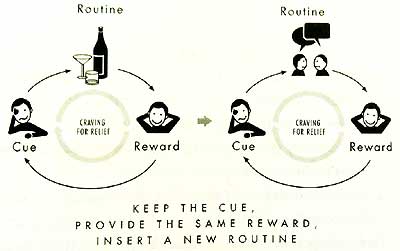
 So much of what we do is automatic. We have to identify the habitual behavior and identify the cues that trigger actions. Eradicating a loop is unlikely. Your best bet is to change the routine you engage in when a cue kicks in.
The key to success is the reward. When your brain gets the cue, it’s going to execute the behavior to get the reward. That’s how brains work. That’s why salad diets don’t work. A salad isn’t a reward. Brains light up with grease, salt and sugar (including alcohol). Pizza and beer. No one says, “Come over for football and a salad.”
The best part of this book is the Appendix which breaks down the steps using an example from the Author’s life.
- Identify the routine
- Experiment with rewards
- Isolate the cue
- Have a plan
First, get mindful of your pattern. Then break it down into stimulus and response. What is the reward? Is it really a desire for cocktails or it is a desire for relaxation? Perhaps for conversation or connection with another?
Step Three: Isolate the Cue
When does this happen? The same time every night, like right after work, or only on Friday at 5 p.m.? He made a list of the location, time, emotional state, other people and immediately preceding action to track down the cue, writing it down every day when he felt the urge.
Step Four is to create a plan to practice a different routine to get the reward. In his example, Charles Duhigg was looking for “a moment of distraction and the opportunity to socialize.” He wanted a break at about 3 p.m. each day. In England, he might have a “cuppa tea.” In fact, that’s what he did. He made a plan to look for a friend at a desk and if no one was to be found, to go the the cafeteria and have a cup of tea, skipping the big sweet cookie that was bad for him.
Obviously, changing some habits can be more difficult. But this framework is a place to start. Sometimes change takes a long time. Sometimes it requires repeated experiments and failures. But once you understand how a habit operates — once you diagnose the cue, the routine and the reward — you gain power over it.