Yearly Archives: 2015

Know Breaks

Know Breaks

Rick Hanson Ph.D., author of Buddha’s Brain, teaches at UC Berkeley. His Positive Neuroplasticity trains your brain to turn passing experiences — like self-compassion, mindfulness, grit, gratitude, and self-worth — into lasting inner resources that are encoded in your nervous system.

His Just One Thing weekly newsletter suggests a simple practice for more joy, more fulfilling relationships, and more peace of mind. Today, the message was to PAUSE.

When the mind is running fast, it can feel like a juggernaut with no brakes. When in a heated discussion, it is important to be able to PAUSE the flow of words so we may consider better responses. Know to take a break. Rick Hansen says:

nobrakesIf need be, PAUSE the interaction altogether by suggesting you talk later, calling time out, or (last resort) telling the other person you’re done for now and hanging up the phone.

Before doing something that could be problematic — like getting high, putting a big purchase on a credit card, firing off an irritated e-mail, or talking about person A to person B — stop and forecast the consequences. Try to imagine them in living color: the good, the bad, and the ugly. Then make your choice.

He recommends that we stop for a few seconds before starting a new activity and tune in to what’s going on, especially our physical feelings, so that we can briefly touch what Richard Miller calls our “inner resource.”  To know breaks give us a chance to regain our center, to calculate the consequences of actions, to compose ourselves, and to know peace.

Training Your Brain

Wendy Sullivan, LMSW, a licensed social worker, developed a set of Just One Thing downloadable cue sheets to help people to structure their efforts to train their brains to feel more peace and joy. Find out more about the Just One Thing book.

Death Rate Jumps 22% for Middle-Aged Whites

Death Rate Jumps 22% for Middle-Aged Whites

NYTimesDyingMiddleAge
The New York Times reported in a front page article that white Americans without a college degree are dying at an accelerated rate due to suicide, fast and slow.

The rising annual death rates among this group are being driven not by the big killers like heart disease and diabetes but by an epidemic of suicides and afflictions stemming from substance abuse: alcoholic liver disease and overdoses of heroin and prescription opioids.

Nobel Prize-winning economist Paul Krugman called it “Despair, American Style” in an op-ed piece today.

In a recent interview Mr. Deaton suggested that middle-aged whites have “lost the narrative of their lives.” That is, their economic setbacks have hit hard because they expected better. Or to put it a bit differently, we’re looking at people who were raised to believe in the American Dream, and are coping badly with its failure to come true.

About a year ago, two of my brothers drank themselves to death on opposite sides on the country. Dave (on the right in the picture below) died on Oct. 5 in Virginia and Greg died on Nov. 17 in Oregon. Both were in their 50’s, both had retired a few years earlier, neither retirement was completely voluntary, neither had finished college. Neither had a strong plan for retirement, both slipped in to spending a lot of time with their best friend, beer. This photo was taken one year prior, on a vacation in Florida.

DaveGreg

In the days following the publication of this alarming data, there was some pushback over methodologies, so Angus Deaton released this drill-down info.
chart

My brothers, who grew up in the 1950’s, rode the post-WWII juggernaut where men were men and drank to prove it. They lived their lives as if everything was going to take care of itself, which was the prevailing assumption in the days of Ozzie & Harriett and Leave It To Beaver. What was different about these two, however, is that they were musicians who became stalled at the “talented amateur” stage. They didn’t pursue enough training to focus their minds or to hone their talent. They never developed a commitment to their art.They never even learned to read music. But their artistic temperaments were difficult to live with, and they numbed themselves. To death.

blackoutSarah Hepola, author of “Blackout: Remembering the things I drank to forget” attributed alcohol addiction to heredity and culture. My brothers did not live in a culture that encouraged thinking in healthy ways. They did not see their father, another talented piano player, take an active part in creating healthier emotions, minimizing emotional suffering and maximizing joy. According to Debbie Joffee Ellis in a letter to the NYTimes, “To create healthy [emotions] requires willingness to think in realistic… ways and to recognize when we are catastrohizing, and then to dispute such thoughts. Don’t worry, think wisely, be healthier and happier.”

The New York Times review of her book says:

Ms. Hepola’s electric prose … has direct access to the midnight gods of torch songs, neon signs, tap beer at a reasonable price, cigarettes and untrammeled longing.

She may have squandered her early carreer
and now is back in Texas, finally publishing her first novel at age 40. I enjoyed the book and I think she is going to beat the odds in the charts above because she finished college, and knew she was a good writer. She made a living at it while she used alcohol as “the gasoline of all adventure.” Now she has sobered up and found her path. I’m so glad.

Station Eleven

Station Eleven

station11The
\NYTimes
loved this bestseller which opens with “King Lear” and moves on to a traveling Shakespeare company with a Star Trek line painted on the truck, “Survival is insufficient.”

The line is from a Star Trek: Voyager episode written by Ronald D. Moore. I enjoyed the book. It’s interesting to read a book that isn’t structured as a movie.

NPR review,

author’s website.

Paris Rental Turned Out Great!

Paris Rental Turned Out Great!

274RueSaintHonore
I was very nervous about renting this Paris apartment through HomeAway.com. There were no reviews, and the landlord required my deposit via bank transfer to a French bank, nearly half up front, and for the remainder to be paid IN CASH, in Euros, on the first day of rental. Plus, I had to provide a check for 500€ for the security deposit when I got the keys. I leave tomorrow morning and I am thrilled to report that the apartment was just as promised, and I have now received back my check for the security deposit! I am a very happy traveler. It was much less expensive and more fun than a hotel or AirBnB. I saved a fortune by preparing all my own meals with the gourmet foodstuffs available all around.

I didn’t have to drag my luggage up any stairs because the apartment was in a ground floor courtyard behind a heavy, locked door to the street and I felt super safe. The room was quiet, with no one above — skylights on the roof of the little unit which is essentially an enclosed porch of an 18th century building. While there are three floor-to ceiling French doors with arched transoms looking out to the cobblestone courtyard, as in the picture, all are protected by locked steel doors which can be opened in the daytime to let in light.

There is high-speed ethernet access and I could stream Netflix. There is switched wi-fi which I could to turn off at night. The cellular signal is strong for both voice and data.

The rusted, slanted, noisy microwave is designed to make sure you don’t microwave French food. There is no oven, no disposal, no freezer, no ice cubes. The glass cooktop works like a charm if you read the manual that is buried in the cloth napkins. Hint: “Lo” means Locked.

The two electric heaters keep the tile-floored room snug. There is plenty of hot water and the water pressure is good.

The studio is well-designed and well-maintained. I couldn’t be happier.

France: high fat diet, lowest heart disease

France: high fat diet, lowest heart disease

quicheAccording to Healthline, the French have the lowest heart disease rate in the world. This quote is from my friend RDS who just returned from two weeks driving around the provinces of France:

Much of the time it was just us and the cows. And the food really reflected that. Lots of meat, cheese, and cream. The only way to get a veggie in a restaurant was to order a meat or fish dish and get a veggie side dish. But as always, everything was beautifully prepared and presented, even in the smallest rural towns.

On the week-long boat ride from Paris to Normandy and back, we got very few salads or vegetables — meals were pretty much as RDS described them. Now that I am at the end of my ten days solo in Paris, I can say that it was a challenge to include salads in my diet, and forget cooked vegetables! But really confuses me is that 99% of the French are thin, many smoke, and based on what is in the stores, sugar must account for 40% of their daily calories.

Yet Americans get heart disease and the French don’t. What is different? For one thing, the French walk everywhere. I am planning to drag my suitcase for 20 minutes tomorrow morning along Rue de Opèra to the Roissybus stop because it is easier than dragging it DOWN into the subway and UP 3 stops later. I could take a cab, but it would still take 20 minutes from start to finish and I am afraid I would get pushback from the cabbie about such a short trip.

Shall I tell my no-oil Vegan friend, a heart attack survivor, that her strategy might be the opposite of what leads to a healthy heart.

No. My new resolution is to stop trying to improve others. Okay, I think I will just go eat some quiche now and wait for the nice French lady to pick up the key for my Paris rental.

I am so happy. It has been a great 10 days.

Turner Exhibit – de Young

Turner Exhibit – de Young

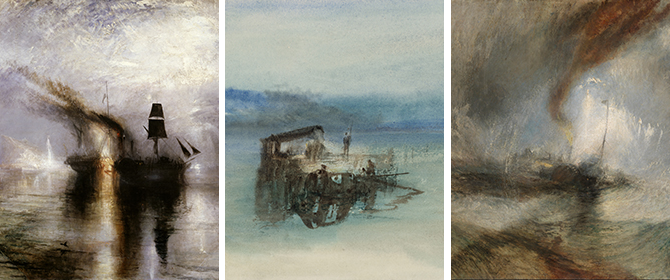
turnerSnowStorm
When I was a teenager, J.M.W. Turner was one of my favorite painters and I squeaked with glee when I discovered that the London museum had an entire WING of his paintings. I think I spent a couple of days there. I liked blurry paintings then — they seemed more artistic than photographic paintings.

Now that everything looks blurry, I prefer paintings with sharp lines, but I didn’t want to miss this show. I enjoyed the movie with some of my art friends, but none of them could go to San Francisco when I could, so I went by myself. It was very crowded, even at 11 a.m. on a Wednesday, so now I know to go as early as possible, and to leave by 1 p.m. to beat the traffic back. It only took about an hour, each way.

This show focuses on work Turner produced from age 60 to 75 and includes some of the scathing criticism by his contemporaries. My favorite is the image on the right, above, of a steamship in a snow storm. The apocryphal story is that Turner had himself lashed to a mast for two hours to experience the storm and watch the steamship founder. The art books at the museum question this story but the painting is very dramatic.

I was struck by Turner’s work ethic, and how much he traveled to find compelling subjects. The watercolors from his visit to Switzerland come with detailed descriptions of the techniques and materials he used. My watercolor friends will love the show!

Tin Foil Hat

Tin Foil Hat

Tin Foil Hat and Feathers

Tin Foil Hat and Feathers

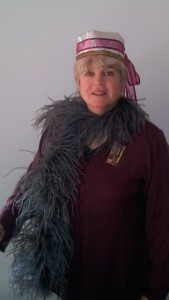
Yesterday I received a flyer from Science Buzz Cafe of a glamorous event to be held at the French Garden that very evening. The flyer said, at the bottom

“Every scientist dreams of seducing people with the beauty and wonder of the natural world. But few take it as far as Lynda Williams — the Physics Chartreuse — who puts her microphone where her mouth is. I really liked the feathers part.” The audience is encouraged to come in costume, especially tinfoil hats and feathers.

Well, she is a chanteuse and she is not chartreuse. Worst of all, I actually CAME in a tin foil hat and feathers!

And no one else did.

Stress Can Be Your Friend

Stress Can Be Your Friend

StressIsYourFriend
People who feel that they control the events in their lives and believe that they can learn fast and perform well end up doing better on nearly every important measure of work performance, according to the team led by University of Florida psychologist Tim Judge.

When you can persuade yourself that you are in control, and you are confident in your ability to adapt quickly to life changes, you can be a top performer.

Ever noticed how you wait until the last minute to start a creative project? Our brains are hard-wired to need anxiety to get started. The chart they developed show that performance peaks and “flow” conditions are created with moderate, managed levels of anxiety.

Convert Anxiety into Excitement

The better you get at managing the anxiety, the better you will perform when facing uncertain or challengine situations. Some techniques”

  • What are the foreseeable pitfalls? Plan the action you will take.
  • Focus on positive actions you can take, turnout the fears of failure.
  • Re-write your script. We live our lives according to what we believe.

embracestress
Kelly McGonigal, Ph.D tells us in this TED Talk that people who view stress as an opportunity for courage or a chance at joy bypass the damaging cardiovascular effects caused by a flood of cortisol.

So, what can you do to regain your center and make stress your friend? How do you turn nervousness into excitement?
unplug