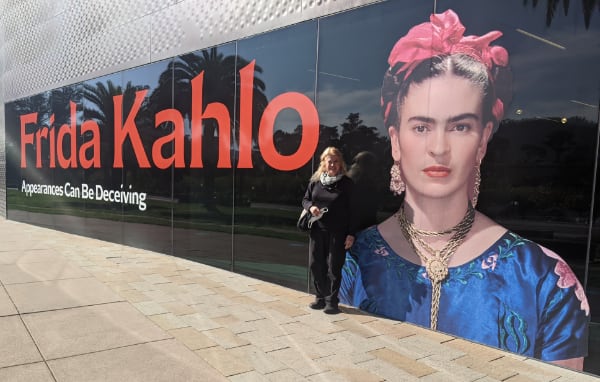
My artist friend, Sue, drove up from Santa Monica to join me for a visit. It was nice that the gallery wasn’t shoulder-to-shoulder with visitors like some previous special exhibitions. This show captures the time when women were objects — I find it useful to think of them as products of their own marketing. Examples from my youth: Jackie Kennedy, Marilyn Monroe, Maria Callas. Like Frida, each was exquisitely aware of her public persona and cultivated it carefully.
Back in Frida’s day, art was narrowly defined by the kinds of things you see in the Louvre: pastoral landscapes, allegories, myths, biblical stories, heroic battles, portraits. This show is much more personal and feminine, and I was stunned to learn that her foot had been amputated and that she died before her husband Diego who was 20 years older. I was also surprised that her father, G. Kahlo, was German-born, and that the Casa Azul belonged to her because her father had bequeathed it to her.
The photographic portraits of her were very interesting to me. Her father was a professional photographer so she knew how to “sit” for a photograph and many famous photographers (Weston, Dorothea Lange) made portraits of her. As her reliance on pain-killers increased, you can see it in her face in the images.
Her father made many photographic self-portraits of himself, and that may have influenced her many self-portrait paintings. The artist I went to the show with has NEVER done a self-portrait, and neither have I.
Of course, the clothes and the story behind the clothes was the centerpiece. I liked the show a lot.