The Brain is Plastic

The Brain is Plastic

No, not MADE of plastic — the brain physically changes when you do the same thing over and over. To me it feels like it creates little grooves in my brain. You have to rest your brain by doing something different — something so absorbing that you are completely diverted from what has exhausted you. You can’t fly an airplane safely and fret about taxes at the same time. You can’t line up a pool shot and plan a marketing strategy simultaneously.

Nobel-prize winner Dr. Kandel, featured on PBS’ show about the brain, is quoted in “The Shallows”:

“The growth and maintenance of new synaptic terminals makes memory persist.” The process also says something important about how, thanks to the plasticity of our brains, our experiences continually shape our behavior and identity: “The fact that a gene must be switched on to form long-term memory shows clearly that genes are not simply determinants of behavior but are also responsive to environmental stimulation, such as learning.”

Learning changes our brain, and continual learning strengthens our “learning muscles.” The more we do something, the better we get at it. But constant pressure can be exhausting.

Two important elements to repair “the little grooves” that we wear into our brains by intense repetition of the same mental activities:

  1. A change of scene and
  2. Doing something different that is creative and absorbing.

How do you relax your brain? Non-verbal play or do you use mental diversions like playing Bridge? What do you think is most effective?

Screensucking in the Shallows

Screensucking in the Shallows

I am reading “The Shallows: How the Internet Affects our Minds” by Nicholas Carr and I came across the May 10 article in the NYTimes Science News on how kids with Attention Deficit Disorder can spend hours in front of a screen.

In fact, a child’s ability to stay focused on a screen, though not anywhere else, is actually characteristic of attention deficit hyperactivity disorder. … Children with A.D.H.D. may find video games even more gratifying than other children do because their dopamine reward circuitry may be otherwise deficient.

The Shallows” postulates that it much harder to have Deep Learning and Deep Thinking when screen sucking. When reading online, every link requires a decision “Do I Click?” and that keeps the thinking shallow. The shallow thinking explains why it is so hard to learn to design websites online. When I am seeking an answer to question A, I am always distracted by the offer of a solution to a tangential problem. This may be why people sign up for classes taught the conventional way, in a classroom. Do you learn better staring at a screen, fully absorbed, or do you prefer a textbook or a class?

In Arabic, Democracy means Decadence

In Arabic, Democracy means Decadence

Michael Scheuer was the chief of the CIAs bin Laden unit from 1996 to 1999 and remained a CIA counterterrorism analyst until 2004. His writing is maddeningly unquotable, and his point of view is hidden until the last pages of the book.
He says that in 1996 he was fortunate to join a small company of CIA officers who worked in the US and overseas, who came to hate bin Laden but who also came to respect his piety, integrity and skills. Their mission was to understand bin Laden’s motivation, to capture or kill him, and to destroy al-Qaeda but it was “thwarted… by self seeking cowardice… in the senior levels of the intelligence community” and by the Clinton and Bush administrations.

Even today, the “former CIA officer who stopped plans to capture bin Laden in 1998-1999 is now President Obama’s senior advisor on ‘extremism.'” When Scheuer left the CIA in 2004, he directed his frustration into training young non-commissioned officers and junior officers for the US Marines and the Army on how al-Qaeda and its allies perceive the world. Many of his trainees were veterans of Iraq or Afghanistan or both. He found them to be “decent, smart, tough and funny, though also cynical and angry.” The experienced officers who had already served overseas had learned that they were not fighting “freedom-hating nihilists, as they senior commanders had told them, but hard-fighting, brave and intelligent men” who were defending their homes and who intended to drive the American invaders out of their country and out of the Muslim world. Scheuer ends the book by praising his trainees, saying “all Americans should support and honor these young… lions [who are] led by self-serving moral cowards.” The political leadership of this country has misled us so that “most of the assumptions Americans have about bin Laden — are dead wrong.” Scheuer wrote the book in the hope that we would stop deceiving ourselves.

The first chapter is practically unreadable but the information in the book is so interesting and so well documented that you might find it worth the trouble, although you might be advised to read it back to front. One of the most cogent passages in the book is a quote from Omar, the son of Osama (p. 111):

My father paused before explaining it this way. “Omar, try to imagine a two-wheeled bicycle. One wheel is made of steel. The other is made of wood. Now, my son, if you wanted to destroy the bicycle, would you destroy the wooden or the steel wheel?”

“The wooden wheel of course, ” I replied.

“You are correct my son. Remember this: America and Israel are one bicycle with two wheels. The wooden wheel represents the United States. The steel wheel represents Israel. Omar, Israel is the stronger power of the two. Does a general attack the strongest line when in battle? No, he concentrates on the weakest part of the line. The Americans are weak. It is best to attack the weakest point first. Once we take out the weak wooden wheel, the steel wheel will automatically fail. Who can ride a bicycle with only one wheel?”

He patted my knee with his hand. “First we obliterate America. By that I don’t mean militarily. We can destroy America from within by making it economically weak, until its markets collapse. When that happens, they will have not interest in supplying Israel with arms, for they will not have extra funds to do so. At that time, the steel wheel will corrode and be destroyed by lack of attention.

“That’s what we [Muslims] did to the Russians. We bled blood from their body in Afghanistan. The Russians spent all their wealth on the war in Afghanistan. When they could no longer finance the war, they fled. After fleeing their whole system collapsed. Holy Warriors defending Afghanistan are the ones responsible for bringing a huge nation to its knees. We can do the same thing with America and Israel. We only have to be patient.”

[see OxfordIslamicStudies.com]

Does Compensation Cut Creativity?

Does Compensation Cut Creativity?

Port AransasMy friend Dee lives in Port Aransas, a charming and artistic beach community on a barrier island near the Southern tip of Texas. Corpus Christi is the nearest city. For a year now, Dee has been writing an interview column for the local newspaper and she just decided that she wants to get paid. Will getting paid erase the fun and wipe out the creativity of writing for the Island Moon?

Academic research shows that if-then rewards are disastrous to creativity. You know — IF you sell newspaper advertising to the business you just profiled, THEN the newspaper will pay you a commission.

Daniel Pink says in his book “Drive” that the research shows that production jobs like auto manufacturing respond to financial incentives (if your production goes up 20% your pay goes up 10%) but the same strategy hobbles creativity. “Straight-forward production responds to incentives,” says Dan Pink, but high-performance creativity requires an unseen intrinsic drive. He says three things are necessary for creative “flow”:

  1. Engagement. The writer cares about the subject and the oucome
  2. Clear goals and immediate feedback
  3. Skill. The writer must believe that he or she can do it

Dee loves Port Aransas, a drinking town with a fishing problem. It is a colorful, artistic beach town on Mustang Island and a fun place to party for the students from the University of Texas at Austin. Dee owns a profitable business that has thrived on her writing talents but she longed for a more creative outlet. She started writing for the Island Moon as a hobby, interviewing the artists and interesting shop owners to get to know her neighbors better. The Island Moon doesn’t pay for writing, and that was a perfect fit because Dee was looking for a social hobby. A year ago, Dee did not want to have to sell advertising to her interviewees, but the Island Moon only pays for selling ads, not for writing. If Dee wants to get paid by the Island Moon, she will have to ask the businesses profiled in Dee-Scoveries if they want to advertise in the newspaper.

Pink thinks that adding compensation to the equation will contaminate the creative urge. He talks about how incentives impact productivity in his highly-watched TED talk on the Surprising Science of Motivation.

If Dee starts to tie in advertising with her interviews, will she begin to choose subjects that are more likely to advertise? Will she start to bypass the unique and quirky personalities that make Port Aransas so interesting? Will this impact her writing? Will it take the fun out of her hobby?

It’s Always 40° at the Coast

It’s Always 40° at the Coast


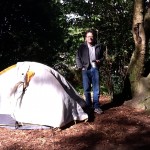
A few days before Mothers Day, Santa Rosa had a record-breaking 89° so we packed up Friday morning and headed to the coast. I remembered how cold it gets so I brought a parka and a knit cap, but Howard didn’t. He also did not pack the extra down sleeping bag we often use as a bedspread. It tends to get very cold around dinner time, then as the temperature differential between the inland valleys and the coast dissipates, it warms up by midnight and stays comfortable throughout the night. But warm stews are the best dinner in the cold California summers! I brought homemade lentil soup and Chicken Tagine, a Moroccan stew made with apricots, chickpeas and bulgar.

Here is a map of the Gualala River Watershed with the ocean and the mouth of the Gualala River in the background. This is a prime spot for whale watching in February when the mothers come close to the sandbar to scratch off their mussels. The county campground is small, lovely and has a full-time camp host so it is very well run. We sat in the tent and read, or sat by the river and read. It was great having the campground to ourselves!

Burn Notice Fans Visit South Beach

Burn Notice Fans Visit South Beach

As fans of Burn Notice, we visited South Beach and Key Biscayne to see the locations. Click on the image of Fiona to see the trailer for the Fall of Sam Axe episode. Using my little waterproof Olympus, I shot a few seconds of video of Howard at the fountain on Lincoln Rd., a gorgeous pedestrian mall of shops and restaurants in South Beach. We were not able to find parking so we have no images of the beach itself, but we got a nice panorama shot from the Village of Key Biscayne with the city of Miami in the distance.

We were returning to the Ft. Lauderdale airport from Miami where we stayed at the Hotel Urbano. I was surprised to learn that the airport was only about an hour from Miami using the fast toll road. We took the slow road and drove North along the beach communities, seeing Bal Harbour and the Trump towers. Wretched excess. I loved it! We were so busy talking, we forgot to put gasoline in the rental car and got dinged $60 for gas when we turned it in.

Here is an iPad video of the panorama of the luxurious Village of Key Biscayne. It is not as sharp as I thought it would be, and it is wobbly because it is hard to hold the iPad steady.

Where the Dopamine Flows Your Energy Goes

Where the Dopamine Flows Your Energy Goes

Today’s NYTimes asks, “Is Sitting a Lethal Activity?” Only 2.4% of Americans over age 60 move around for at least 30 minutes per day.  Our bodies are designed to be farmers, or hunter-gatherers, not desk-bound knowledge workers. In a study of people who were forced to overeat and prevented from exercising, some gained weight and some didn’t. Why?

“The people who didn’t gain weight were unconsciously moving around more,” Dr. Jensen says. They hadn’t started exercising more — that was prohibited by the study. Their bodies simply responded naturally by making more little movements than they had before the overfeeding began, like taking the stairs, trotting down the hall to the office water cooler, bustling about with chores at home or simply fidgeting. On average, the subjects who gained weight sat two hours more per day than those who hadn’t.

We know that dopamine controls movement and mood. People often eat to feel better. Sometimes they go for a walk/jog/run to feel better. Dance or make love or other pleasurable vigorous activity. We know that exercise elevates mode.

Did you know that obese people have lethargic dopamine receptors? The top left image shows the brain scan of a normal person eating. Next to it is the cooler, bluer scan of the obese person eating. Not as much excitement. See article.

The two hot images below them show that, overall, normal weight and obese people have similar brain metabolic activity. The big difference is whether eating lights up their pleasure center (dopamine receptors).

The bottom chart shows Body Mass Index (BMI) from low (skinny) on the left to high (fat) on the right. The number of dopamine receptors that are lit up by food PLUNGES the fatter you get. In terms of getting a dopamine boost, the more you eat, the less you get. Does fat lower dopamine receptors or the other way around? Could this be nature’s way of taking the fun out of eating? See this article from about a year ago.

The results support the notion that type 2 dopamine receptors (D2DR) — brain receptors that have been shown to play a key role in addiction — also play a key role in the rats’ heightened response to food. In fact, as the rats became obese, the levels of D2DR in the brain’s reward circuit decreased. This drop in D2DR is similar to that previously seen in humans addicted to drugs like cocaine or heroin.

We know that movement and non-verbal play lifts mood (increases dopamine). Isn’t it interesting to learn that using food to lift mood becomes a dull weapon the more we use it? This is the paradox that to get more energy, you need to spend more energy.
Nature can be harsh.

Ghost Orchid Fakahatchee Strand

Ghost Orchid Fakahatchee Strand

I’ll never look at orchids the same way after hunting for the elusive Ghost Orchid with John Kalafarski, a brilliant botanist and all around genius. Fakahatchee Strand Preserve State Park is a strip of land between Alligator Alley (Interstate 75) at the North and the Tamiami Trail (U.S. 41) to the South. It encompasses much of Florida’s most spectacular swamp. More native orchid species grow in this 75,000 acre wilderness than in any other place on the continent. There is an 11 mile park road, but the park is a wilderness and the goal is to preserve its natural character. We hiked the “mud tram” which is a rickety wooden boardwalk made of two boards precariously balanced on 4×4’s driven into the black swamp muck underfoot.

Fakahatchee ghost orchidWe were seeking the elusive Ghost Orchid which blooms at the start of the summer rainy season. After a long dry winter, this leafless orchid appears briefly in just a few rare locations where the conditions are just right. John, our guide, visits this area often and has a botanist’s eye for the details that lead to the tiny but dramatic wild orchids that flower in the Fakahatchee. John was hoping that we would find the Ghost Orchid on our hike in the middle of April. There had been a brief rain a few days before and the ground was damp, but conditions were not yet perfect and we did not see one despite the Photshoped photo to the left. John wanted to stake out where the orchid was going to bloom so that he could return in a few days’ time to see the bloom, but because the Ghost Orchid does not have any leaves, there is no indicator where it will appear. Botanists have to haunt the territory looking for the blooms. The lucky ones are hiking in tropical rain, swatting mosquitoes as big as the orchids themselves.

The most exciting part was hearing the rumble of an alligator as a jet plane went overhead. John explained that alligators are not afraid of humans, but they don’t understand the sound of the jets overhead and it agitates them. A few steps further and we could smell the alligator who had created a Gator Hole in the black swamp muck. The muck itself was actually clean smelling, just decaying leaves mostly, John dug up a handful for us to sniff. It looked muddy but was actually rather crumbly. We circled around the gator hole so we upwind of the gator and Howard got a pretty good photo.

John explained that the early Spanish visitors called this critter a lizard “legato” so The Lizard is El Legato. Ellygato. Corrupted to ellygotta, then alligator.


Anet’s 27 second walk through Everglades ferns. iframe embed plays in iPad2


Howard’s Video as Anet and John discuss finding time to read and the classic Twilight Zone episode that ends with Burgess Meredith’s glasses being broken.

Everglades Area Tours

Everglades Area Tours

The Everglades are beautiful.  We kayaked in a mangrove tunnel with a bird guide and watched a little gator flee.  The next day, an ex-Marine power boated us out to the 10,000 islands so we could kayak in salt water to see manatees and turtles and to visit a small island with a sandy beach, hardwoods at the center and a portapotty.  While we were on the island, some canoe campers landed, planning to spend the night. They were touring and camping in the islands (that looks like a fun trip!).  The following day we spent several hours in the Fakahatchee strip, a botanists paradise, with a Ph.D. naturalist looking for Ghost orchids.  Didn’t find any, but heard, smelled and saw a gator at his hole.   Very gushy hike.

It is fun and absorbing to be in an environment so different from home.  Their rainy season is the summer.  The Glades come alive when the water arrives.  They told us if we could tolerate the heat, humidity and mosquitoes, the Glades were at their best in the summer.