Tag Archives: Art

Granat XXeme – Aix

Granat XXeme – Aix

I love visiting art museums and I found a gem. It is the annex of the main art museum in Aix-en-Provence which is to Marseille (second largest city in France) what Healdsburg is to San Francisco. The main museum is amazing with unbroken marble busts going back to Roman times that have come from private collections. Aix was founded by Romans because of its plentiful water including hot springs. It is a city full of fountains.

Granet XXeme is the “annex” and is a repurposed church built in 1649 for the “white Carmelite” brotherhood. The vaulted ceiling creates a lot of space over walls scrubbed clean after the building was used by the city for hay storage. Many religious buildings were forcefully decommissioned during the French Revolution.

Jean Planque worked in a Swiss art gallery which enabled him to meet and befriend up-and-coming artists. He had a wonderful eye but not much money. In the 50’s and 60s he struck up a friendship with Picasso and eventually received five of his paintings from that era. Here are two. There are photos in the exhibition of how Jean Planque’s collection looked hanging in his modest house, including Renoir, Monet, Van Gogh, Braque and Dubuffet works.

Jean Planque died about 10 years ago and a foundation was formed to try to keep his collection together for exhibition as a whole. For me, it really works because I can feel his point-of-view on what makes a painting great. There was a coherence to this show that I rarely experience.
https://www.museegranet-aixenprovence.fr/en/collections/collections/granet-xxth-jean-planque-collection

Jean said he learned a lot from Dubuffet and his collection includes paintings by him that look like something, some that sorta look like something, and a few striking ones that look like squid-ink spaghetti. Here’s a link to 3 of the works:
https://www.museegranet-aixenprovence.fr/collections/les-collections/granet-xxe-collection-jean-planque/les-oeuvres/dubuffet-et-lart-brut

Picasso Man & Woman

Joan Brown SFMOMA

Joan Brown SFMOMA


This one almost got away from us. Originally scheduled on a Thursday morning, we discovered the museum opens late on Thursdays so we moved our visit to Tuesday. But the driver/docent developed sniffles and only the two of us who were planning to go by train/ferry on a crisp winter day made the trip. Also, with no RSVP, I felt someone had to show up in case there was anyone we didn’t know about (there wasn’t).

The artist’s early abstract expressionism was commercially very successful. Abstract in the sense you could tell the subject was a dog or a toddler, her canvasses featured heavy impasto and were sought by NYC and L.A. galleries and collectors. After the birth of her child, the artist’s style began to change to something more like Picasso’s, whom she admired. Her work became biographical, as Picasso’s is, and she developed her own distinctive visual style, as Picasso did. But large faces are hard to live with, and collectors planning to display in a residential setting were not attracted. Nevertheless, she kept painting, divorcing, marrying, traveling and seeking spiritually.

There were many self-portraits, and Dianne noticed one with the artist wearing a similar jacket and a wild 1960s hat, so she asked for this shot. Dianne knew how to get to the glass elevator that rises on an angle to reach Salesforce Park where we walked the length on our way to the museum. I had some fun posing in front of the gold curtain by the 1960’s exhibit.

Asian Art Museum – 2022

Asian Art Museum – 2022
Bernice Bine Mural Asian Art Museum

Bernice Bing Mural with Dianne, Pat and Nanette

The OLLI Art Club visited the Asian Art Museum in San Francisco on Saturday 19 November. Nanette collected us at Pat’s condo and drove us there on a beautiful autumn morning.

Jade Money Tree

We were delighted to find a Christmas bazaar on the ground floor with many wonderful textiles from around the world, but the exotic treasures on the third floor captivated us. We delighted at the sight of the rare 3,000 year old Bronze Age Chinese rhino, and I loved this jade “money tree” crafted from intricately carved wafers of jade. I wonder if the wafers themselves were used as currency?

We struggled with the audio app that we downloaded: it was hard to figure out how to use it, and the text was gray on a white background, typical design by young artists who don’t realize that aging eyes lose contrast (which is why you see Emails from your grandparents written in bold). The third floor has art from South Asia, the Persian World and West Asia, Southeast Asia, the Himalayas and the Tibetan Buddhist art as well as the fabled Chinese jade.

The architectural mash-up of the neoclassical library and the new museum is always a delight. I urged my friends to ascend in the glass elevator and descend on the semi-exterior escalators, then through the almost hidden doors to the magnificent marble stairway in the center of the old library and the stunning, renovated Samsung Hall.

Bronze Age Chinese Rhino Asian Art Museum

Bronze Age Chinese Rhino

We were able to get the $27 value tickets through Sonoma Library Discover and Go which was a learning experience. The tickets need to be reserved, and the reservation held until a day to two before the actual visit, when it needs to be cancelled or printed. If you print it at the time of reservation, you can’t cancel it and because there are limited number of spaces allocated, you deprive someone of using it if your plans change and you can’t go. Worse, you use up your own allotment of free tickets through the service. Nevertheless, we figured out how to use and it it was great!

Dianne had researched luncheon options and she chose Chao Pescao at 272 McAllister Street, just a few steps from the museum. The decor and food was wonderful! A very successful day.

Chao Pescao San Francisco

Dianne and Nanette at Chao Pescao

OLLI Art Paradise Winery Sculpture

OLLI Art Paradise Winery Sculpture
Paradise Ridge Sculpture

War Side of Mask Sculpture
photo by Nanette Simmons

Walter Byck, owner of the sculpture garden at Paradise Ridge Winery, gave the OLLI Art Club a tour, followed by a lunch hosted by Connie Codding.

This bus-shelter shaped sculpture has a WAR side holding ceramic masks of horror and loss. Stepping inside, one can see the inside of each mask, painted with the emotions of rage, revenge, domination and all that leads to war. On the other side of the “bus-shelter” are the PEACE masks: both the inside feelings and the outside manifestations of peace, joy, connection, safety, friendship and community.

Walter, in his 90s, walked us around, pointing with his cane at the kinetic sculpture by Ned Kahn and other electronic, motion-sensor, sound-emitting works. He unlocked “The Shoe” and Steering Committee Member Nanette went all the way up, taking photos of the top floor. More than twenty people joined us for the tour and talk.

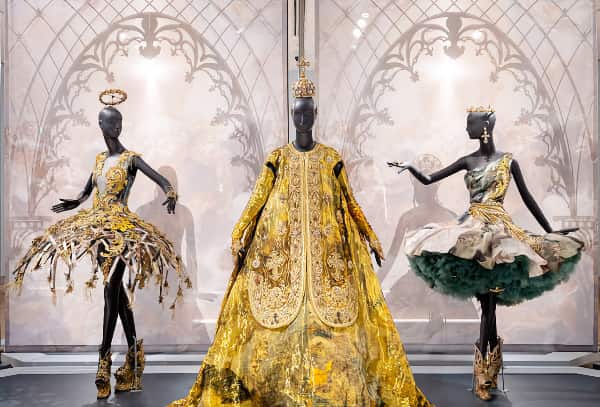
Guo Pei at Legion of Honor

Guo Pei at Legion of Honor

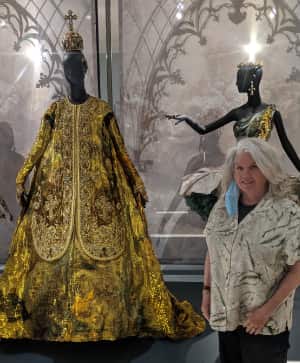
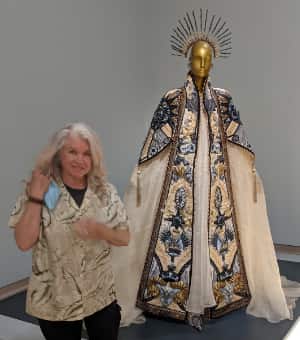
Visited the fabulous Guo Pei Exhibit at the Legion of Honor — it is as astonishing as my friends described!

This dress looks like a tabernacle to me.

I got a ride to San Francisco with hiking buddy Laura because the lease on her electric car is coming to an end and she needs to use up the miles. My membership in the Fine Arts Museum allows two tickets, so it worked out for both of us!

The photographs do not capture the architecture or dazzling use of materials by Guo Pei. It is truly something that needs to be seen in person to be appreciated. I’m so glad that the Fine Arts Museums of San Francisco art show more work by people who aren’t straight, Christian, able-bodied white males.

Apple Blossom Art Show

Apple Blossom Art Show

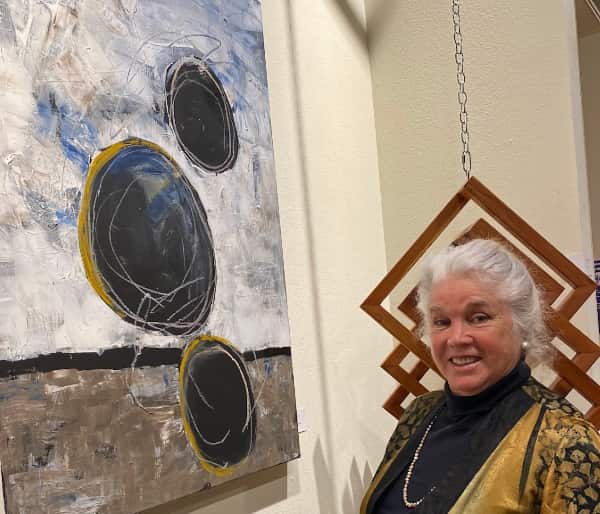
Linda Loveland Reid took this snap of me standing next to one of her three paintings on display at the opening reception for the Apple Blossom Festival. Interestingly, in the main gallery adjacent at the Sebastopol Center for the Arts, a poem by Linda was on display next to the painting to which it referred — an example of Ekphrasis. Notice my “Covid hair” styled to hide the growing-out blonde tresses.

Photo by Linda Loveland Reid

California Funk Art – SVMA

California Funk Art – SVMA

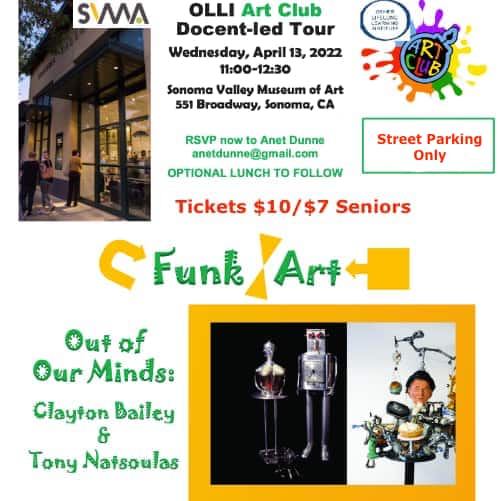
About 12 of us visited the Sonoma Valley Museum of Art in the city of Sonoma to check out the work of Clayton Bailey and Tony Natsoulas. It is a small museum, but I think many of us were eager to explore again after two years of COVID isolation. This is the first trip I led and I forgot to take a group photo in the gallery. I was so happy Linda Loveland Reid offered to drive carpool — I was nervous and really appreciated the company and the ride. Linda made the cool flyer below.

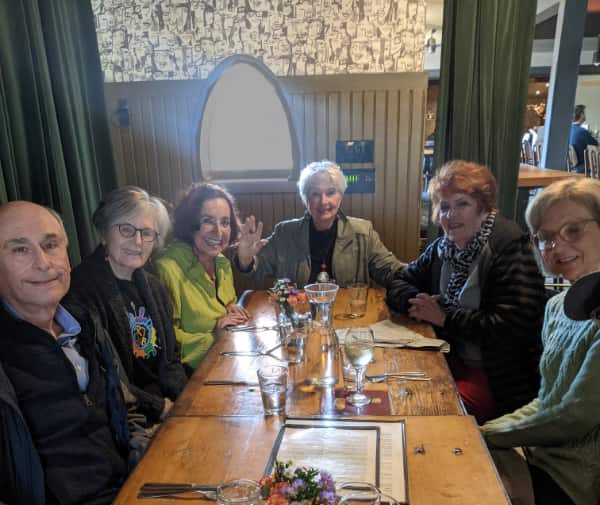
We received many suggestions for lunch places and selected Hopmonk tavern, recommended by the gallery, because it is just down the street at 691 Broadway and can handle big groups. Here are a few of the nine or so who were there.

Other recommendations were The Red Grape 529 First St. West, Sunflower Cafe, El Dorado Kitchen, Sonoma Grill (fish), Oso (closed Wednesday, the day of our visit).

Abstract Expressionism

Abstract Expressionism

A few days ago, Linda Loveland Reid gave a wonderful talk on Rauschenberg and Jasper Johns as a fundraiser for the Sebastopol Center for the arts. As I though about Abstract Expressionism and its impact on artists, I sent this Email to Linda.

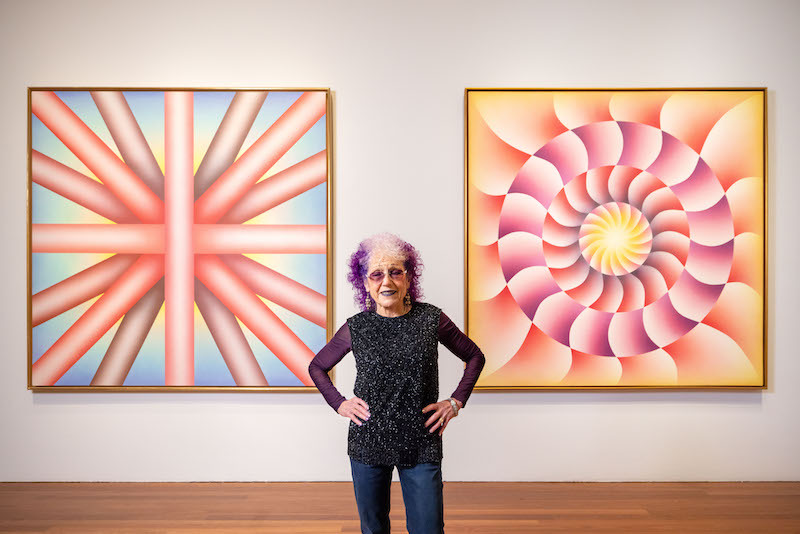
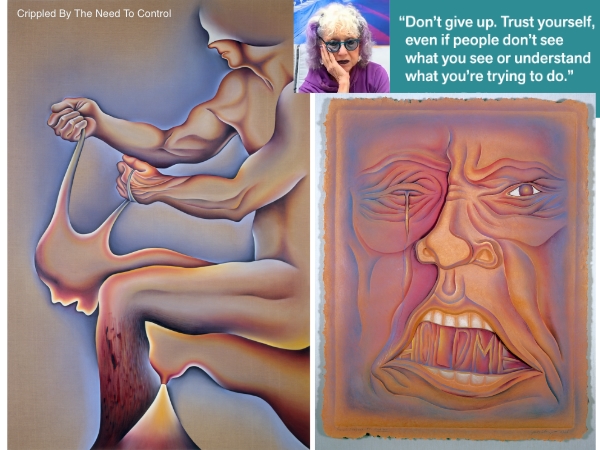
I have been thinking about what you said about Abstract Expressionism. I remember Judy Chicago’s rage at being excluded from prestige museums despite producing art that seemed to be exactly what they defined. The ones we saw at the DeYoung show were “perfect.”

Judy Chicago Abstract Impressionism

I think the art establishment used the stringent intellectual shibboleths as a way to exclude people they didn’t like — clangorous Judy Chicago, for example, or not-straight white males like Rauschenberg and Jasper Johns. The Art Establishment clinging to their elite status was like trying to hold a wolf by the ears.

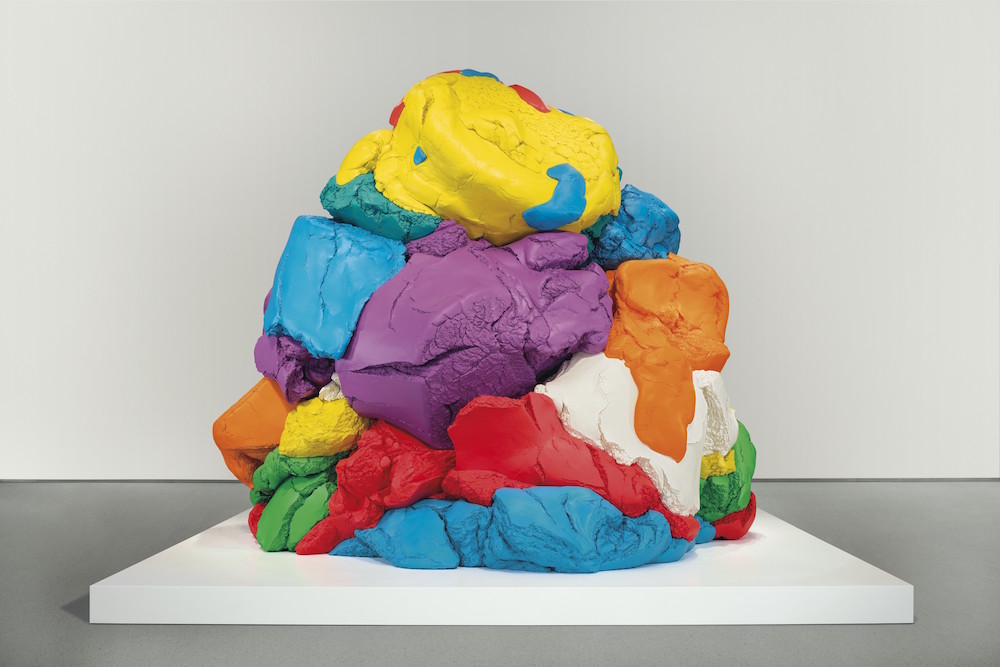
Their forceful superiority got knocked down so far that the neo-Dadaists were supplanted by Pop artists. And yet two prime examples of tall, slim, elegant, educated, congenial, social male artists are Diebenkorn and Jeff Koons. I never could figure out why Koons got away with the stuff he peddled until I saw him speak on a panel at the Getty Museum in Malibu as part of their “Plato” show. The Getty was actually displaying his “Play-Doh” as part of the exhibition ancient Greek and Roman art as a play-on-words. The room-size sculpture is made of enameled aluminum, and yet somehow it seemed to smell like the children’s toy.

Koons Play Dough

When elegant, refined Koons spoke, I could see why the new-money in L.A. swooned over him. It really felt, to me, like “The Emperor’s New Clothes.”

Koons’s work made me long for abstract expressionism in all its christian-white-male-chauvinist glory.

Judy Chicago DeYoung

Judy Chicago DeYoung

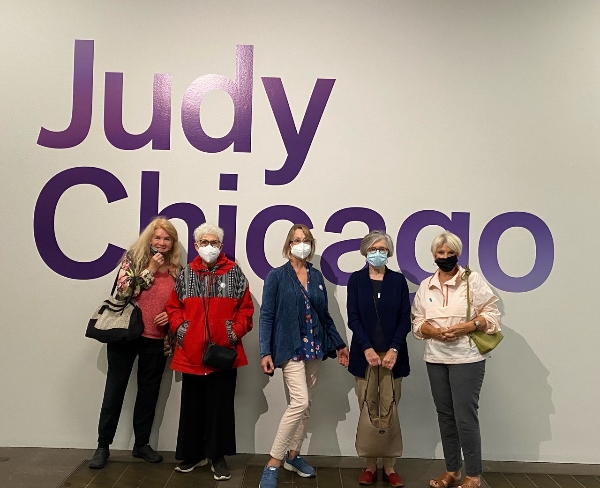
Tuesday, 7 September, Linda Loveland Reid drove to SF with Osha and me to visit the Judy Chicago show at the DeYoung, and to meet my friend Sue.

Visiting SF

Dianne and Osha join me on nice September day

Sue had come up from Santa Monica and met us at the entrance to the exhibit. Sue had visited some of Judy Chicago’s Southern California art buildings back in their heyday.

visiting Judy Chicago at DeYoung

I am joined by Sue, Osha, Dianne, and LLR

The show was unusual because Judy Chicago had persuaded the (excellent) curator to show it as a true retrospective — newest work first, working back to her earliest work. It was staggeringly clear how hard Judy Chicago worked to be taken seriously by the museum-level art world and how difficult the male-dominated art establishment made her life. The range of her work and materials is impressive and the newest stuff is the best. Here are a few pieces I found especially moving.

Her most famous piece “Dinner Party” is permanently installed in Brooklyn, but there was a film and some examples of the challenges they faced getting the immense project completed and displayed. I saw it in L.A. at the Hammer Museum with Sasha Ferrer who gave me the catalog book as a gift which I cherish to this day.

I bought A Painting

I bought A Painting
painting by Isabelle

á la soupe, as hung

In 2014, I took a Sierra Club trip to Loon Lake, led by Isabelle. I met Liam on that trip and taught him how to say “buon giorno!” I returned to Loon Lake several times, including this private trip, also with Isabelle and Liam.

Isabelle was born in France and her father bequeathed her the family stone cottage in the southeast part of France, about an hour from the Rhone river. She would go back every year to make sure it was okay and to keep her ownership intact. The pandemic took a financial toll and Isabelle decided to retire, which required moving back to France permanently.

She decided to sell the oil paintings that were studies from her portrait class. This is titled “á la soupe” because that is what the French say when it is time to come to the dinner table. “French people eat soup for dinner,” Isabelle said.


Isabelle said that the decision to retire was difficult because she had spent about 20 years building her business as an acupuncturist. Her resilience shows in her journey of self compassion.