Category Archives: Books

Alex Karp: The Tech Republic

Alex Karp: The Tech Republic

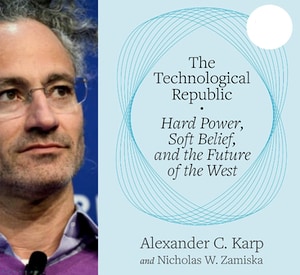
book jacket

Alexander Caedmon Karp is the CEO of Palantir which he co-founded with Peter Thiel whom he met at Stanford Law School where they both earned law degrees. Alex went on to finish a doctorate in social theory from Goethe University Frankfurt, writing his thesis in German. Alex still lives in Germany half-time with New Hampshire being his U.S. residence.

He is 58, born in NYC, father a Jewish pediatrician, mother a Black American artist. In his Dealbook Summit interview, he talked about his dyslexia and I saw his restless twisting in his chair. He said he was bullied as a kid, and his writing (p. 215) jumps around.

But constructing a technological republic, a rich and thriving and raucously creative communal experiment — not merely the bacchanal of permissive egalitarianism of which Strauss warned — will require an embrace of value, virtue, and culture, the very things that the present generation was taught to abhor.

The “Hard Power” in his title is technological superiority: in Afghanistan Palantir software pulled together many data points to determine IED locations, and mapped online networks of dissidents. “Soft Belief” is his contempt for the Americans he sees as soft weenies with no strong sense of what it means to be American. He offers the Randy Travis song “Three Wooden Crosses” as an example of the American mythology he wants. The song is very emotional and tells a story of redemption over three generations.

Paradoxically, as he argues for more passion for one’s beliefs, he himself seems emotionally stunted, tribal, and bellicose. He yearns for the passion of a strong sense of country, a national sense of honor. He builds software so his team can win, and he passionately believes that the brightest minds should be making high-technology weapons, not games and shopping apps. He seems emotionally stuck at the age where he wants More Power! Hard Power! Death to the weenies!

I had not considered how unmooring it might be to be mixed. On page 202 he talks about Martin Walser, one of Germany’s leading writers and public intellectuals who suggested that the yoke of an enforced remembrance [of the holocaust] should be thrown off and abandoned — that the imposition of shame on a contemporary German public had ceased to serve any productive purpose. On page 204 Karp clarifies:

An intense skepticism of German identity, of allowing any sense of the nation to take hold in the wreckage of the war, has had significant costs and deprived the continent of a credible deterrent to Russian aggression…. Our persistent unease with broader forms of collective identity must be set aside. To abandon the hope of unity… is to abandon any real chance of survival… The future belongs to those who… fight for something singular and new.

Rebuilding this national sense of unity would (page 215 quoting Irving Kristol, 1985) “breathe new life into the older, now largely comatose, religious orthodoxies.”

I’m so grateful for thinkers like Lynne Twist who said:

There are two forces present in our world. The unawakened masculine is everywhere in our global conflicts and crises: in the military power plays; in the extraction and exploitation of our Earth environment; in an unjust and unsustainable economy; in misogyny that objectifies and harms women and girls.

But there is another force rising now as well. The awakened feminine. This is the emergence of what I call the Sophia Century, a time when the qualities long dismissed as “soft” or secondary become essential to our survival: interconnectedness, compassion, intuition, nurturing, harmony, and healing. These are not only women’s values. They are human values, and our future depends on them.

This is my “Soft Belief.” Go weenies!

Lloyd Blankfein’s Memoir

Lloyd Blankfein’s Memoir

I was fascinated by this February 2026 NYTimes interview by Andrew Ross Sorkin of Lloyd Blankfein, former C.E.O. of Goldman Sachs. It really validates the misguided intentions of Neoliberalism. Let’s look at how Bill Clinton’s deregulation of the banks affected the nation’s economy.

I think if every bank had managed its risk the way we did, we wouldn’t have had a banking crisis.

“Going into the 2008 financial crisis, I thought I was cynical about politics. It turned out that I wasn’t cynical enough,”

Lloyd B described himself as grounded in the old partnership model where the partners were investing their own money. “I was a very risk-oriented, risk manager guy.” Looking back, he considers the financial crisis as a gift. “If I had had perfect knowledge, I would have gone out and shorted every security instead of being flat.”

His successor is the first C.E.O. that was never a partner of Goldman Sachs. “He’s rooted in a public world, and is doing things […] that our owners, which are the public shareholders, want him to do and are probably benefiting from. He’s completing the orientation of Goldman Sachs as a public company.”

“A major factor in the erosion of the fairness of our society was a feeling that the well-to-do got bailed out and the receptionist that put down payments on three apartments didn’t.” He balanced the greed of the receptionist with three apartments with the greed of the bank making the loans, pointing out that the central bank doesn’t lend to people or institutions; it lends to banks. “A recession that is also a banking crisis is a much more difficult thing to sort out.”

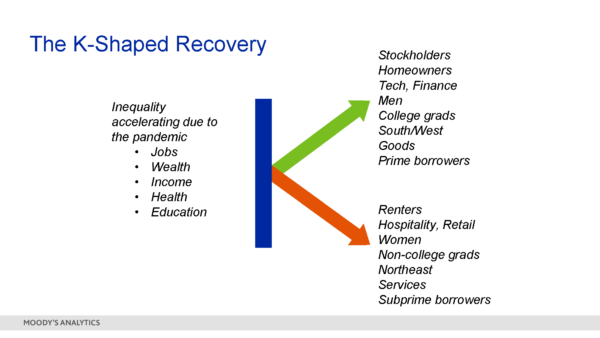
K shaped curves

After Covid, Recovery Has Been K-Shaped

“Paper Girl” Trauma Feedback Loop

“Paper Girl” Trauma Feedback Loop

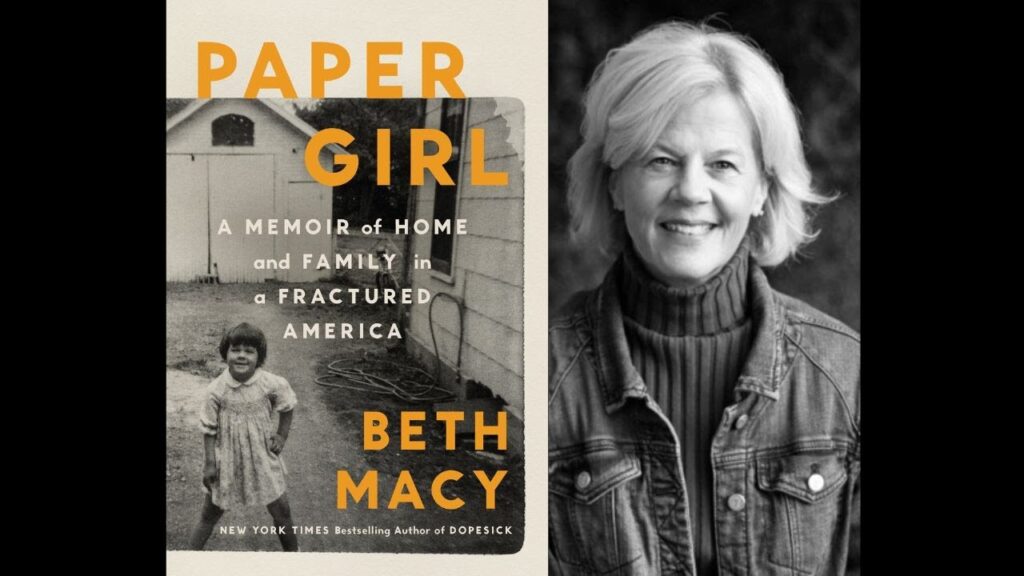
This “Memoir of Home and Family in a Fractured America” is at the top of Obama’s list of recommended books. I thought it would help me understand why a majority of Americans in 2024 voted for a lying, thieving, unfaithful criminal.
Beth Macy grew up in Urbana, Ohio and left in the mid-1980s to became a journalist. Not surprisingly, she blames the loss of local newspapers as an underlying reason for the loss of pride-of-place. The solutions she offers are well-meaning but shallow.

The book describes the implosion of the middle-class way of life in her hometown: manufacturing jobs moving overseas, technology replacing manual and low-level white collar jobs, and the decline of labor unions. She clarified how the Civil Rights law was used to force Blacks into the labor unions, creating race tensions that were deliberately inflamed to weaken the union.

The middle class was further eroded by “the fact that government stopped thinking of higher education as a public good and basically privatized it to the tune of $1.75 trillion in individual student debt.” Author Macy emphasizes that her pathway out of poverty was paved by the Pell Grant that sent her to college. Government stopped adequate funding of Pell Grants as Neoliberalism shifted priorities from “the common good” to “shareholder value.” She quotes philosopher Richard Rorty who predicted in 1998 that globalization and growing inequality would eventually lead to widespread class resentment and, eventually to fascism:

      Members of labor unions and unorganized unskilled workers will sooner or later realize that their government is not even trying to prevent wages from sinking or to prevent jobs from being exported. Around the same time, they will realize that suburban white-collar workers — themselves, desperately afraid of being downsized — are not going to let them selves be taxed to provide social benefits for anyone else.
      At that point, something will crack. The nonsuburban electorate will decide that the system has failed and start looking around for a strongman to vote for — someone willing to assure them that, once he is elected, the smug bureaucrats, tricky lawyers, overpaid bond salesmen, and postmodernist professors will no longer be calling the shots…
      One thing that is very likely to happen is that the gains made in the past forty years by black and brown Americans, and by homosexuals, will be wiped out. Jocular contempt for women will come back into fashion…. All the resentment which badly educated Americans feel about having their manners dictated to them by college graduates will find an outlet.”

Arlie Russell Hochschild’s 2024 book “Stolen Pride” is referenced, pointing to a pride paradox where the shared working class value of self-sufficiency gets twisted into self-blame for the betrayal by “the market” of Neoliberalism. “Doubly blocked [by corporations and government policy], they become vulnerable to structural shame,” and more apt to embrace authoritarians, the radical right, and the notion that it’s okay to convert their shame to blame — of gays, immigrants, people of color, and liberals.”

It isn’t until the end of the book that the reader discovers that both of the author’s children are queer (her word) and one of them is transgender, revealing her anguish at the imminent loss of their fragile safety and social acceptance. She brings us into the world of Travis, a high school aged girl-to-boy transsexual. On page 111, counseling professor Tania Israel wondered if one of the reasons Beth Macy wrote the book was, “Maybe you just want your son to be loved, ya know?”

Another focus is her niece Liza who was trapped in a household with her sexually abusive step father and she could not get help from her mother, her pastor, or the police. The book does a good job of (1) showing how deep the hole is for people like Travis and Liza and (2) the blindness of the HAVES to the children of people who are violent, addicted, and under-educated.


Rigid thinking is a trauma response

Nikki King, the addiction scholar, is quoted on page 302, “Rigid thinking is a trauma response.” Trauma alters how the nervous system detects and prioritizes safety and danger. In an environment of diminishing opportunity and fading hope, a self-reinforcing loop organizes around protection rather than connection, narrowing perception and limiting available responses.

In a place like Urbana, where so many are stuck in minimum-wage jobs and burdened by families that need more than is available, people are surrounded by anger, resentment, and despair. As the demands for time and money increase, the nervous system organizes around protecting themselves from further demands rather than connecting to the people who are asking for attention, time, and money. To defend themselves from the onslaught of demands, a person’s perception tends to narrow to the easiest response. Creeping despair limits resourcefulness. The energy erodes for a range of useful emotional responses. The emotionally exhausted and financially-depleted person rattles into a rut of rage against easy targets, echoed by the people in their social silo.
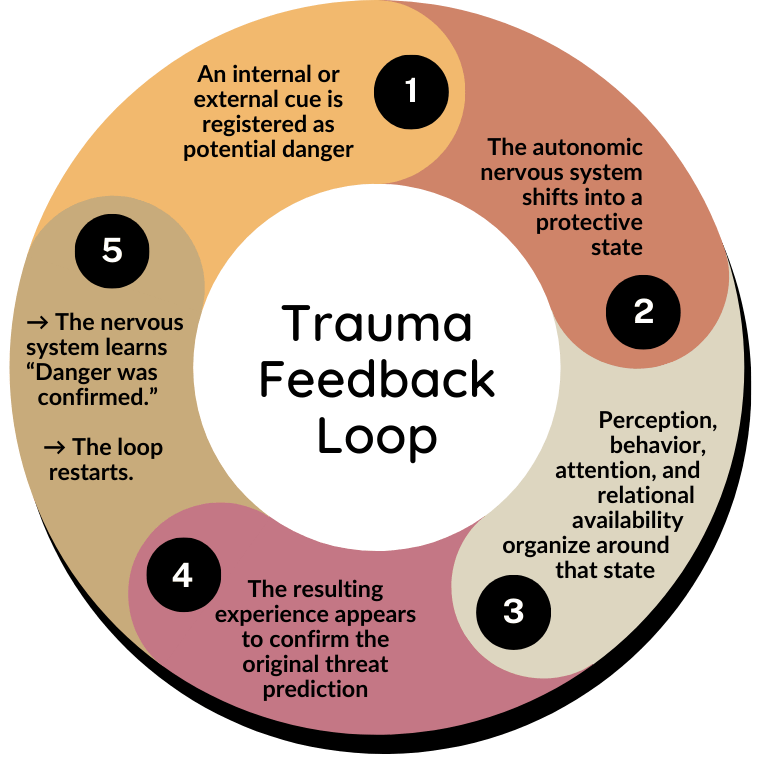
Trauma Feedback Loop – How We Get Trapped in “Silos” of GroupThink

Survival strategies become habitual, predictable, persistent, and
costly: physically, emotionally, and financially. People get stuck.


How to Escape the Trauma Feedback Loop

Resolving the problem of angry, resentful voters in places like Urbana requires many simultaneous approaches. Among them are

  1. Making the effort to get out of the Trauma Feedback loop,
  2. Improving access to more helpful news media and social media
  3. Making education affordable and accessible including funding for transportation

The three simultaneous efforts to unpeel the Trauma Feedback loop are:

  1. Learning to feel something other than rage. Becoming curious-not-furious
  2. When activated, and making the effort to be curious-not-furious, ask yourself, “What story am I telling myself? What memory is this triggering? What am I predicting?”
  3. Know how to calm your activated body enough to be able to make a rational choice about what to do. To be able to chose to RESPOND WITH INTEGRITY, prioritizing building families on a foundation of trust, and prioritizing trust in close relationships. Choosing not to lash out like a sleep-deprived toddler, or sulk like a teenager on junk food. Choosing instead to act like an adult with a fully-developed brain that can calculate the consequences of actions.

Calculating the Consequences of Actions

Is this a reasonable request, to expect full-grown people to engage their whole brains and take that nano-second to shape a useful RESPONSE rather than to react like a four year old on a sugar high? Studies on soldiers returning with PTSD show us that traumatized adults do not make rational decisions — they have emotional reactions. The Trauma Feedback Loop shows how this reactive behavior is self-reinforcing.

People trapped in the Trauma Feedback Loop display chronic hypervigilance, often ping-ponging between (1) emotional shutdown, withdrawal, and stonewalling and (2) anger, even rage, directed at the people closest to them or toward scapegoats like “woke” people. Research shows that even when traumatized adults have insight to their PTSD and make the intention to be more rational in their responses, ongoing physiological dysregulation hijacks that effort. The body always wins. When the nervous system is triggered, it will protect. The brain is designed for survival, not for singing Kumbaya.

For these adults economically trapped and traumatized by feeling helpless, this destructive behavior is not a failure of motivation, awareness, or effort —- it is a nervous system doing exactly what it is designed to do: to survive. The threatened brain does not pause to calculate the consequences of actions. This calculation of consequences is limited to people who feel relatively safe and relatively calm.

How to Interrupt the Loop

In order to learn, people need to feel relatively safe and relatively calm. The challenge is to create an atmosphere of trust to foster a physiological change inside the nervous system, in real time, by:

  • Identifying early nervous system shifts before defensive reactions fully mobilize
  • Tracking what is triggering the reactions at the level of bodily neuroception
  • Slowing or interrupting defensive momentum without overriding safety
  • Expanding access to a broader range of physiological and relational responses
  • Supporting the nervous system in updating safety through lived experience — not explanation.

“Updating through lived experience” is also called “learning,” but people need to feel safe and calm to begin to remodel the nervous system. An atmosphere of trust works best.

When people stuck in the trauma feedback loop can reorganize their nervous systems enough so that their responses are usually kind and thoughtful, they regain trusting access to their families, curiosity about the people and world around them, a sense of agency both economically and socially, and emotional availability without getting hijacked back to the lash-out-numb-out survival reaction.

Banking, Business and Society are Built on Trust
1950s man in Fedora

When America was Great?

While I have talked a lot about safety, I believe the real issue is trust. Would you go to work if you did not believe that you would get a check on payday?

I think a deep layer of rage is toward the betrayal of the “promise” after WWII that Americans who worked hard would be able to have the American Dream of a house and life better than their parents. If there were still good factory jobs and only three television networks, would we have the bifurcated communications environment of today? What went wrong?

Broadly, two things (1) undoing Glass-Steagall and (2) changing the law to require “maximizing shareholder value.”

After the stock market crash of 1929, banking and finance was reformed by New Deal reforms such as the Glass-Steagall Act which separated commercial and investment banking. Never again would the wealthy and powerful play monopoly with regular people’s money. Lloyd Blankfein refers to this in a recent interview.

Laws passed by Congress were undermined in the courts, as described in the book The Quiet Coup. Prior to that, most companies included employee and community welfare in their planning and actions. Neoliberalism was the fancy word for the greed that took hold again under Ronald Reagan during the 1980s under the guise of “smaller government, lower taxes, less regulation.” Academics like Milton Friedman and economists like Alan Greenspan jumped on the bandwagon and many Democrats followed suit creating the conditions we see in Urbana now. NAFTA was negotiated by President George H.W. Bush and signed into law by Bill Clinton, who further deregulated banking and finance.

Some people think that hitting rock bottom again, as we did in 1929, will wise Americans up and we will begin to create “new” New Deal. Conversely, maybe economically disadvantaged Americans will fall further into fascism. What I wonder is: when the middle-class “knowledge workers” suddenly lose their jobs to A.I. and they are forced into the some economic trauma as the working class of Urbana, will they too become reactionary fascists?

Corporations are creations of the law and Mehrsa Baradaran says we need to change the laws so these creations have responsibilities to the society that makes their profits possible. The gospel of “shareholder value” only reaped great rewards for those companies with a single or small number of major or exclusive shareholders.

For the most part, widely held companies were either driven out of business — so the valuable parts could be acquired — or bought up in leveraged buyouts to be broken up and sold by the “Barbarians at the Gate.”

The Evolution of Trust

Nicky Case created a 30-minute game that uses Game Theory and the Prisoner’s Dilemma to play out the probabilities of The Evolution of Trust.

Fascinating and insightful, it sets the groundwork for another prediction game that demonstrates why communities like Urbana, built by immigrants, become so hostile to new immigrants.

YouTube channel Veritasium (the element of truth) riffed off the graphics created by Nicky Case to explore the question “Can you really reach anyone in six steps?” The figures in green represent TRUSTED people. Think of them as people in Urbana. Reds are distrusted, let’s say new immigrants to Urbana.

In the leftmost image with three green trusted Urbana residents at the top, imagine they are all connected by the simple garland, no shorcuts. Trust grows organically at the edges — people come to trust those with whom they have repeated good interactions. Add the shortcuts of green-to-red and red-to-red and the system quickly becomes all red. Trust disappears from the system, the cooperators were crushed.
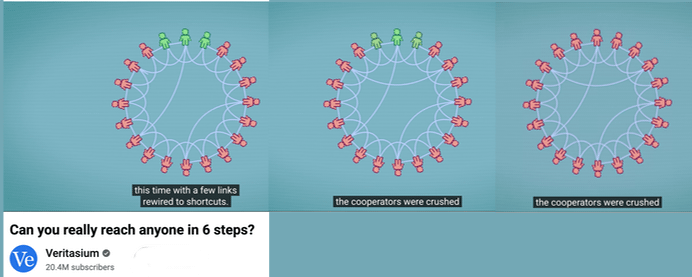
Click for YouTube Veritasium Video

As trust erodes in our communities, our financial systems and society itself is undermined. I think the answer is to restore trust in ourselves, our families, our neighbors, our communities, and our citizenship. This has to be done on a one-to-one basis. We need to learn how to build trust with people who are not like us. We need to step out of our media echo chambers.

The Author’s Solution

On page 301, Beth Macy outlines her solutions:

  • strengthen public schools,
  • invigorate “real life with other human beings including those we don’t know,”
  • support local news,
  • run for local office and/or support candidates who are trying to change things for the better for most people.

My solution is less glib. The middle class resents paying taxes to support the jobless, blind to their own impending slide into joblessness via A.I. displacement. Life is not a football game. It is time to shift from us-versus-them thinking and to do the hard work of finding and executing win-win strategies. Stop wasting energy by protesting the Rich. The Rich will always be with us. In a democracy, we bear the load we can. We are all in this together. No one gets out alive, so pitch in and connect. Create ways to make things better for most people. Find a way to make the best of what we have. Share the wealth. Get smart and consider strategic forgiveness in what Nicky Case calls the Copykitten way of getting ahead while creating community.
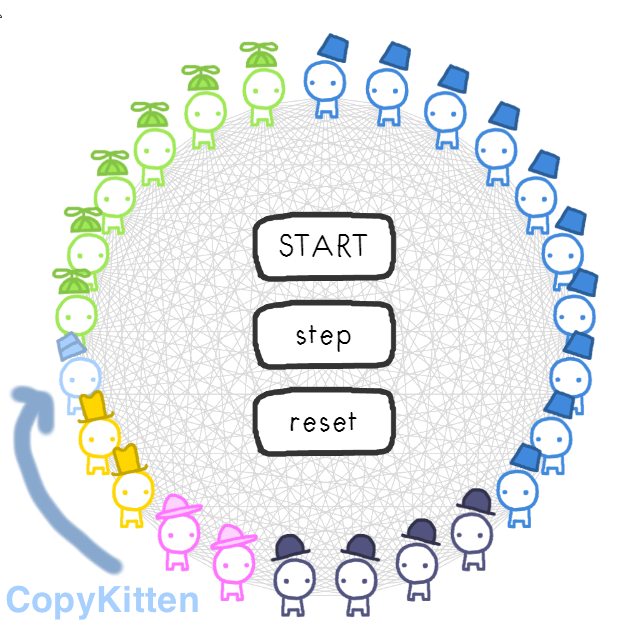
screenshot from Evolution of Trust Game

Click Image for Evolution of Trust Game by Nicky Case
Quiet Coup by Mehrsa Baradaran

Quiet Coup by Mehrsa Baradaran
Mehrsa Baradaran

Interesting ideas flagged

The blue paper flags in The Quiet Coup mark jarring insights by Mehrsa Baradaran, a professor of law specializing in banking law at UC-Irvine. This searing indictment of the theory of “Law and Economics” is subtitled Neoliberalism and the Looting of America. Neoliberalism is a blanket term that describes

  • market-driven,
  • state-enabled
  • deregulation that prioritizes
  • capital mobility and
  • privatization of commerce
  • rather than prioritizing the public good.

The conclusion on page 349 points to the utter failure of the promises of neoliberalism:

  • increased market competition
  • more opportunity for all
  • fewer taxes going to wasteful government spending
  • and more liberty to pursue our own dreams

Money doesn’t Trickle Down — It Flows Up

In an unfettered market, capital multiplies. The rich get richer and the poor get poorer.

Reaganonomics
Supply-Side Economics
Voo-doo Economics

To combat the stagflation in 1980, presidential candidate Ronald Reagan touted “supply-side economics” promising that it would incentivize production and investment by deregulation, and lowering government spending and reducing taxes. George H.W. Bush correctly dismissed this as “voo-doo economics” because he understood that removing safeguards increased the “speed of greed.”

Regulations protect the citizens and small businesses upon which this economy is founded. Lowered government spending slowed growth. Reducing taxes on corporations increased the paychecks of CEOs but not the W-2 workers.

Trust is the Basis of Currency, Banking, and Society

Professor Baradaran points out that the value of any currency is simply that people believe it is worth something. Banking only works if people believe that they can get their money out when they want to. Social order is based on trust and it crumbles in riots. She says on p. 350

Neoliberalism taught us to distrust the state and one another… We are tyrannized by both a bloated government bureaucracy and a cannibalizing capital market: the guys who buy the guns, and the guys who sell them.

The past twenty years have shown us that humans are not the rational, self-interested decision-makers that Professor Milton Freidman claimed. Market behavior is not rational — it is driven by emotion. The strongest of these is the Trust/Distrust axis. On p. 351 she says,

We evolved as community builders, and our greatest feats have required groups of humans to work toward a common goal for long periods of time. Turning polarities into harmony — that is the magic of humanity. It is TRUST that is the vital force underlying both state and market. And corruption is the death knell of both.

Harmony – What If Democracy Is a Song?

“Turning polarities into harmony — that is the magic of humanity.”

Since the runaway inflation of the 1980s turned into “stagflation,” the electorate has ping-ponged between candidates who promise lower taxes and regulation, and those who promise to tame greed, corruption and inequalities. I think Professor Baradaran is right, these are different notes to the symphony of democracy and it would make better sense to find a way to harmonize.

Democracy is a song

Neoliberalism is a zero-sum mentality stuck in 19th-century laisex-faire economic ideas. On p. 352 she points out that “Segregationists, wealthy heirs, big-oil and tobacco are trying to preserve an unjust world economic order.”

Can we find a way to harmonize creativity, ambition and greed with “the greatest good for the greatest number”? What if a robust economic system is not a balance or a paradox. What if it’s a harmony. Can we find a way to hear all the voices?

Milton Friedman

Other voices in the harmony are academics. For example, the Chicago School of Economics Nobel Prizewinner Milton Friedman seemed to sing “Nothing is as permanent as a temporary government program.” He believed government regulation slows financial growth. On p. 85 Professor Baradaran said, “Friedman was not alone in his crusade against corporate responsibility… Shareholder supremacy took hold of the Delaware courts over the next decades…”

Chairman of the Federal Reserve Alan Greenspan would sing “A free market is self-regulating and derivatives are trivial. Get rid of rules.” Famous for his inscrutable testimony, he believed that the self-interest of free markets and banks would adequately regulate them. When investment banks Bear Stearns and Lehman Brothers failed in 2008 and nearly brought down the world banking system, Chairman Greenspan famously admitted he was wrong. This was during a House Committee of Government Oversight and Reform hearing on October 23, 2008.

Greenspan and Friedman could have been right, back when investment banks they were run by partners who decided the risk and return of each investment. They were using their own money. After President Jimmy Carter deregulated banks, firms like Goldman Sachs went public in 1999. Now they were corporations instead of partnerships and they were investing the corporation’s money: other people’s money. They paid themselves fees, so transactions were rewarded and Mergers and Acquisitions exploded. Leverage borrowing was the fuel that burned down the markets in 2008.

There will always be the voices of the greedy seeking to unshackle themselves from the regulation that impedes their fleecing of investors.

Greenspan and Friedman did not take into account the greed of bankers who were no longer working in partnerships, who were no longer investing the partnerships’s money. To correct this after the 2008 crisis, the Dodd-Frank bill was signed in 2010 by President Obama to place safeguards in banking. It was partly repealed by President Trump in 2018.

I can’t help but wonder if some of this greed is stunted development. Psychologists tell us that before age 3 toddlers engage in side-by-side play rather than cooperative play. Toddlers are learning what belongs to them (“mine!”) and they lack the ability to understand what others want. They engage in side-by-side Parallel Play and might be encouraged to take turns during a game, but toddlers usually don’t understand sharing in the sense of giving up the toy and then getting the toy back later. Regulating markets has been one way of coping with this behavior in adults.

There is also the question of mild autism like Asperger’s, an inability to understand that others have needs and that society expects adults to help out those who have less. Elon Musk announced his Asperger’s on Saturday Night Live, and Bill Gates, now famous for his Epstein friendship, is also said to be Asperger’s. Alex Karp, co-founder of Palantir, said during a NYtimes panel that he has Asperger’s. This limitation affects their business decisions.

For the craving for money is the root of all sorts of evils. [1 Timothy 6:10 New Testament]
Radix malorum est cupiditas The root of evil is cupiditas -> greed

The Law of Unexpected Consequences

Ralph Nader unwittingly set the groundwork for Citizens United

In 1976, Ralph Nader won a consumer rights case before the Supreme Court which established First Amendment protection for commercial speech by ruling that Virginia’s ban on advertising prescription drug prices was unconstitutional. It upheld Ralph Nader’s contention that the free flow of commercial information is vital to the public. Virginia State Board of Pharmacy v. Virginia Citizens Consumer Council, Inc. This was the change of precedent that led to the travesty of Citizens United in 2010.

Citizens United v. Federal Election Commission held that the First Amendment prohibits the government from restricting independent political expenditures by corporations, unions, and associations. Corporate lawyer Lewis Powell sent a memo in 1971 to a friend who was the chairman of the U.S. Chamber of Commerce. Titled “Attack on American Free Enterprise Systems” it was “full of practical strategies covering a range pf issues, making it one of the most significant documents of the neoliberal revolution in America” p. 85. This was part of the formation of the Federalist Society, covered in Chapter Five, with founding members from the Olin Corporation and industries most threatened by changing markets: big oil, tobacco and weapons.

Lewis Powell went on to become a member of the Supreme Court and was a leader in shifting the decisions from what was best for the people to what was best for the corporations and markets. He was proud of his achievement of keeping black children out of white classrooms in Virginia — de facto segregation.

The Paradox of TIAA-CREF

TIAA-CREF is the leading financial advisor for more than five million teachers, firefighters, police officers, hospital workers, college professors, and people who walk across a variety of public sector jobs. The five million people are part of the disappearing middle class whose jobs and lives have been eroded by the efficiency-minded logic of the financialized neoliberal economy.

TIAA-CREF is a big capital reservoir of middle-class pensions that is invested like any other Wall Street portfolio: maximize returns. Worker’s retirement savings were fed into the same financialized market that squeezed empathy out of hospitals and turned them into businesses. On p. 349 Professor Baradaran says, “Neoliberalism’s trick was to enable a privileged few to cheat the market, loot our shared resources, and seize the ladders of opportunity.” The market is neither Divine nor Evil; it is an algorithm designed to maximize return-on-investment, making the rich richer and the poor poorer.

Integrity is Expensive but it is Not a Luxury

At the Munich Security Conference in February 2026, Representative Alexandria Ocasio-Cortez spoke about the intersection of economic inequality and the rise of far-right populism. She challenged the elite, pro-establishment conference attendees, arguing that runaway inequality fuels far-right populist movements. The security of the individual erodes as power and wealth become increasingly unequal. One threat is the power of surveillance as it becomes concentrated in fewer entities, often corporations like Palantir rather than elected governments.

On page 359 Professor Baradaran states:

I now believe that for those of us fighting for economic justice, it is time to look toward the MARKETS for solutions, because now money has more rights than voters,
and corporations have more power more than governments…

The neoliberal coalition did not want trade on fair terms, so they rigged the game.

Mehrsa Baradaran

Professor Baradaran contends that the neoliberal push to turn people into “entrepreneurs of themselves” is deluded and serves commerce rather than society. To insist that every American is solely responsible for their own success or failure is delusional. As a society, we must do more to provide education to anyone eager to study because a robust democracy is stabilized by voters who are able to think and who can make the effort to understand the many sides of complex issues.

Mehrsa Baradaran was born in Iran where her mother was imprisoned for political protest. Upon her mother’s release, they emigrated to the US when Mehrsa was about 8 years old.

Mokyr: the Lever of Riches

Mokyr: the Lever of Riches


I spent most of Sept, 2025 in Belgium in an effort to understand why the Industrial Revolution seemed to bypass Catholic Ireland while Protestant England got rich. This question formed as I listened to 180 episodes of The History of the Germans podcast. Addressing that question directly seemed too painful so I reframed it as “why did the Dutch Protestants get rich and the Dutch Catholics stagnate after the 30 Years War?”

The Thirty Years’ War, fought primarily in Central Europe between 1618 and 1648, was one of the most destructive conflicts in human history. An estimated 4.5 to 8 million soldiers and civilians died from the effects of battle, famine, or disease, with parts of Germany reporting population declines of over 50%.


The trip helped me to understand that the reasons were complex and included Corruption, Capital, and Contracts. Shortly after I got home, Joel Mokyr was awarded 50% of the 2025 Nobel Prize in Economicsfor having identified the prerequisites for sustained [economic] growth through technological progress.

Joel Mokyr used historical sources as one means to uncover the causes of sustained growth becoming the new normal. He demonstrated that if innovations are to succeed one another in a self-generating process, we not only need to know that something works, but we also need to have scientific explanations for why. The latter was often lacking prior to the industrial revolution, which made it difficult to build upon new discoveries and inventions. He also emphasized the importance of society being open to new ideas and allowing change.

I promptly read Mokyr’s book “The Lever of Riches” (1990). He likes to point out that, before his innovative reading of economic history, people tended to quote Adam Smith about how countries and cultures got rich..

Moktyr described his contribution as the requirement for Useful Knowledge (this is Mokyr’s slide). Inventors needed to understand the science behind the technology (like how steam engines work) in order to develop things like the four-stroke engine or the hot air balloon. Metallurgy was needed in addition to knowledge of printing to develop the alloy that allowed movable type. Creating colorful dyed fabrics required understanding chemistry and developing aniline dyes.


Antwerp/Ghent/Bruges in Belgium was the fine fabric capital of the world in the 1500s

Moktyr’s “Gains from trade before the Industrial Revolution” in the slide above meant real goods, traded in person. “Value added” in the 1500s meant shipping English wool up the Scheldt River to Bruges/Ghent/Antwerp where it was spun and finished into fine fabric and dyed with the organic colors available at the time. English wool was sometimes blended with French flax which the Belgian specialists could weave into luxury linen. The wool and flax fibers were processed by hand in family workshops, usually in the home. There were trade secrets passed down through families. Because all the work was at home and everyone participated, child care was not separate from paying work. Everyone took part in the family business, maintaining the home and taking care of the children.


“Good institutions” in the slide above meant that the Guilds were strong and the cities operated with much autonomy from the sometimes-changing monarchies that claimed them. Taxes meant that merchants carrying wool from England weren’t dinged at every town they passed on the Scheldt River on their way to Antwerp. “Peace” is crucial for stable market-building and the refinement of fiber processing to looming into fabric and the production of goods for sale.

Peace collapsed in 1618 with the start of the Thirty Years’ War over territory and religion which forced the Dutch-speaking Protestants and Sephardic Jews out of Spanish Hapsburg Catholic controlled Antwerp/Ghent/Bruges to Dutch-speaking territory in the North, Amsterdam, which in 1600 was a little fishing village at the bottom of a bay that opened to the North Sea. The Dutch protestant fisherman knew how to build boats that could travel the North Sea. The weavers and merchants needed to get their goods to market, safely bypassing the wars on land. They needed bigger boats and the money-lenders could provide the capital to build them. But would the merchants pay back the loans, or simply kill the money-lenders as the Catholics tended to do in Southern Belgium?

Wikipedia “Reformed Christianity” observes:

Calvin expressed himself on usury…when he criticized the use of certain passages of scripture invoked by people opposed to the charging of interest. He reinterpreted some of these passages, […] saying that money should be lent to people in dire need without hope of interest, while a modest interest rate of 5% should be permitted in relation to other borrowers.

As the wars continued and millions died in these small countries, millions more fled the countryside. Those with skills, ambition and the “Protestant Work Ethic” of discipline, diligence and frugality prospered in Amsterdam. Plundering soldiers destroyed farms which were then lost to “enclosure” by aristocrats who simply expropriated the farmland. Eventually there were no farms or villages for displaced people to return to so the merchants expanded outward, eventually colonizing the New World in search of riches.

Riches, money, capital became the new goal. Max Weber observed that good fortune from hard work was seen as a vindication of God in one’s life. Protestant Capitalists came to believe that profitable actions were blessings from God that proved their right to possess even greater wealth. Some Capitalists took this to the extreme of pursuing unlimited wealth through colonization, slavery on plantations and in mines, wiping out South American natives with disease and stealing their gold and silver, eradicating Mayan documents, artifacts, and culture, etc.

On page 176, Mokyr refers to Marx’s famous dictum that his purpose was not just to understand the world but to change it. Mokyr says that this value applied to “thousands of tinkerers, mechanics, and engineers who built the windmills, clocks and fully rigged ships of medieval Europe.” This pursuit of functional improvement was seen in commerce, war, and politics was decisive. European pragmatism in this period far outstripped most non-European societies, according to Mokyr.

Corruption, Capital, Contracts

As the Reformation changed religion from the old medieval Corrupt (selling of indulgences, the sin of Simony, clerical concubines, etc) to the pursuit of Capital, we should also look at Contracts. Mokyr says that Patent systems did not emerge until the fifteenth century and turned out to be a double-edged sword for inventors (p.177).

“What is clear is that between 1750 and 1850 the British political system unflinchingly supported the winners over the losers, on both matters of technological progress and, increasingly, free trade. On the eve of the Industrial Revolution the British ruling class had most of its assets in real estate and agriculture; it had no interest in resisting the factory and the machine. (p.256)

The British ruling class had grabbed most of the land, forcing the peasants into cities where factories were starting up. Patent and commercial law developed favoring the merchants taking financial risks to develop mechanical looms and factories. The land-owning aristocrats did not interfere with the bourgeois legal proceedings in patents and contracts. Scot James Watt (steam engine) and Englishman Richard Arkwright (water-powered cotton spinning) became famous and wealthy men. “As the technology of building roads and canals improved in the 1700s, Britain became an integrated market system. p. 245”

In 1600s Catholic Belgium there was tremendous resistance to mechanical spinning and looming which displaced generations of Belgians who had created luxury hand made fabric with poor quality and much cheaper woven goods.

“After 1760, guilds came under pressure in France and Germany, and were abolished in 1784 in Southern Netherlands. The French Revolution abolished them in France in 1791 and subsequently in areas that fell under French domination. By 1815 the guilds had either been fatally weakened or abolished altogether on the Continent. … However, the Revolution’s long term effect was to clear up the debris of the ancien régime on the continent, thus assuring Europe’s ability eventually to follow Britain in revolutionizing its productive systems. (p.259)”

Yet, even Britain, the cradle of the technologies that created the Industrial Revolution lost its preeminence in the late 1800s and early 1900s due to resistance to change by entrenched businesses and the rise of technical universities in Germany and Netherlands.

The other 50% of the 2025 Nobel Prize in Economics went to Philippe Aghion and Peter Howitt for creating a mathematical model in 1992 for what is called creative destruction, yet Mokyr mentions it on page 261 as a crucial component of continued creativity. The Nobel Prize committee went on to say:

“When a new and better product enters the market, the companies selling the older products lose out. The innovation represents something new and is thus creative. However, it is also destructive, as the company whose technology becomes passé is outcompeted.

In different ways, the laureates show how creative destruction creates conflicts that must be managed in a constructive manner. Otherwise, innovation will be blocked by established companies and interest groups that risk being put at a disadvantage.

“The laureates’ work shows that economic growth cannot be taken for granted. We must uphold the mechanisms that underly creative destruction, so that we do not fall back into stagnation,” says John Hassler, Chair of the Committee for the prize in economic sciences.

On page 298 Mokyr makes a key parallel between evolutionary biology and human creativity: they happen both with big mutations like the primate divergence from 48-chromosome apes to 46-chromosome humans, and in small mutations like skin color to compensate for levels of sunshine. Both are necessary, valuable, and sometimes hard to cope with. I would add one biological note: in order for people to learn and innovate, they need to be relatively safe and relatively calm.

My favorite line in the book is from page 164 where Mokyr says,

“Why were the Dutch so much more adept at sea than, say, the Irish? And why did Portugal after 1500 fail to develop spillover effects similar to those of the Netherlands?”

I Won An Award!

I Won An Award!

History of the German Podcast Award

I just won an award on Facebook from the podcaster “History of the Germans” who recently broadcast his 200th episode. I am only on episode 180.

Growing up in post WW2 NYC, my babysitter was the TV. It would be more than 20 years before Sesame Street was invented to give children something more wholesome than WW2 propaganda movies that ran in daytime TV. The terrifying war movies indoctrinated me to fear Germans. My European travel had been limited to Catholic France and Catholic Italy and the art I saw was mostly Crucifixions, Madonnas and Martyrs. I had been trained to believe that Heresy was a mortal sin and Martin Luther the Heretic was burning in Hell for Eternity. I was stunned when I saw, in a brief stop-over in Frankfurt a couple of years ago, a painting of Martin Luther that lionized him as if he were Washington Crossing the Delaware.

When I got back from Belgium in late Seeptember 2025 I posted this to the Facebook page for the podcast and the (!) podcaster wrote back to me!

Facebook Post to History of the Germans Podcast Page

I got a “heart” reply to the comment about German portions and the badge. 😁

Kristin Hannah – “The Women”

Kristin Hannah – “The Women”

My sister Mary Rose recommended “The Women” and commented,”When I chat with women who have read it, they’ve each mentioned something different that struck them deeply — none of which was the thing that struck me. Veddy interesting. Rye was the horrid bad guy in the whole story, in my opinion.
“You could be a hero,” he says to an impressionable young Frankie. Grrr. Those stupid words provoked her bravado so that she could impress her dad and have a place on his office wall.
Well, that certainly backfired.”

I agree that Rye, the lying cheat, was the horrid bad guy in the story. And the book blames Rye for Frankie’s decision to try to be a hero and get on her father’s “Wall of Honor.” I think it is interesting that the writer chose to make the father Irish-born, and wrote the mother as someone struggling with alcohol for years.

I read many first-person nurse stories when I was preparing my China Beach spec script. This book was written by a younger woman who created a composite Frankie. From my point-of-view, Frankie was already a “hero child” growing up with an incapacitated mother whom she would rescue, and an emotionally-distant father who harbored contempt for females. Frankie’s love of feeling “competent and needed” prompted her decision to re-up as her first tour was coming to an end. She had finally started to feel skillful and valued.

Part of PTSD is the loss of ability to feel connected to people who love you, well-described in Frankie’s relationship with Dr. Acevedo when she returned to Coronado. Dr. Acevedo did not need her. Rye “needed” her. That was the hook he had, that kept her coming back even when it was contrary to her values. That was the slippery slope that sent her into self-destructive addiction. Giving up herself, in order to feel needed.

The writer had to paint some reason for Frankie to want to be a hero so she pinned it on Rye, the lying cheat. But in real life, there are children who learn to survive by becoming the hero in the family. The kid who does the work that the impaired parents can’t do, the kid who gets attention only for what she does. No love for simply being a kid. To be valued, she has to turn into a little adult. A “parentalized child.” A hero, who is safe only when she is competent and needed.

Election Prep Books

Election Prep Books


Preparing for Fall OLLI classes at SSU, I read these two books to try to understand why the polls failed so catastrophically to predict the election of The Orange One in 2016, and how the effects of that were felt in the government agencies in Washington, D.C.

Seth Stephens-Davidowitz worked for one-and-a-half years as a data scientist at Google and his book explains the bias in polling why political polling is likely to become even more difficult to do well. He received his BA in philosophy, Phi Beta Kappa, from Stanford, and his PhD in economics from Harvard. Comparing what people search for, with what they tell another human they want, reveals that people try to hide their unacceptable desires which is why many told pollsters they were undecided in 2016 when in fact they gave in to their desire for entitlement and privilege. His examples range from sexual searches to baseball history and illustrate how “bias” creeps into sampling. Engrossing.

Michael Lewis writes so brilliantly about statistics. He recounts the effect of the failure of new Trump administration, in 2017, to fill the job openings at the top of many government agencies, most notably the Commerce Department. Lewis comments that the Commerce department isn’t really about business, it’s more the department of science and measurement, including NOAA, and managing nuclear waste. It reminded me of my trip to Morocco a year ago.

In Morocco, once a French colony, most of the road signs in Casablanca (the largest city) and in Rabat (where the French located the capital) were in both Arabic and French. As we got closer to the desert tribes in the East, French disappeared from the signs and they were in Arabic and Amazeigh, the recently-invented written Berber language which looks like a mashup of Greek and Korean letters. Until recently, these languages were unwritten. In public school, mandatory until 8th grade, only Arabic and Amazeigh are taught. French is not taught. The Roman alphabet is not taught. Only the wealthy, who go to private French schools, can read European books. The king of Morocco runs the public schools, and it is better for the monarchy if his subjects do not read European books.

This seems to be the underlying driver for dismantling the “deep state” bureaucracy which enforces the rules and standards across all administrations. The president can change every four years, but the Commerce Department rules are supposed to remain consistent for all citizens over time. These rules and those of the EPA grated against oil companies who wanted to roll back “the Chevron Rule” created by the Supreme Court which is the legal doctrine that the EPA knows more about environmental safety than congressional representatives do, so that when Congress empowers the EPA to regulate oil drilling, there is no need for Congress to pass a law over every single thing — the EPA can set standards. The “Chevron Rule” was rolled back this year by the Trump-packed Supreme Court.

Pete Buttigieg said that JD Vance, if elected, plans to march through government institutions looking for people with “woke” agendas and “de-bathify” the civil service. Fears are that this would enable corporations to maximize their profits as they ignore the safety of citizens. On the Jon Stewart Show, guest Mark Cuban pointed out that Trump’s father ran a family-owned real estate business which he bequeathed to his son. The son inherited the properties and Cuban asked Stewart, “how is running a family owned business different from running a kingdom?” Stewart’s eyes widened. “It’s not very different, is it?”

Felt Sense Polyvagal Model Course

Felt Sense Polyvagal Model Course

FSPM Certificate of Completion

It took six months and more than $1000 to earn the FSPM Completion Certificate (and an additional Focusing.org certification that I am professionally-trained in Focusing) and I learned a LOT. The course tuition was a gift from my brother Tim (thanks, Tim).

In 1985 I bought my first copy of “Focusing” by Gene Gendlin, Ph.D. on the recommendation of a Buddhist nun teaching a course at Point Reyes that was part of my shift from selling TV time to writing full time. I tried to focus by myself, and I read the book many times, but I never got real traction with focusing.

I ordered Jan Winhall’s book before it was even published and realized that it precisely targeted the kind of treatment I needed. I joined the third cohort of her FSPM class taught online through the Polyvagal Institute. Some of what I learned:

  • PTSD can be broken into two main categories. First: what happens to adults, such as on the battlefield or after an assault or car crash.
  • Second: what happens to children. Calling it by the same name as adult Shell Shock is not good medicine.
  • PTSD is usually thought of as physical threat, and this kind of trauma is associated with the fear of being killed.
  • Moral Injury is a different type of PTSD and also occurs in the context of war but requires different treatment. Here is the Veteran’s website on the issue.
  • Traumatic events can be public, like war; private, like the death of a parent or the loss of a platoon member; or secret, like child sexual abuse or being commanded to murder a bound prisoner.
  • Healing secret moral injury requires more than acknowledging it. Some events require an actual sense of being forgiven.

The FSPM class added several very powerful elements to the classic Gendlin model.

  • Actually focusing with another person revealed what Gendlin calls “the power of human presence” which seemed to create a kind of “force field” that kept me from wiggling out of looking at what was coming up to be seen.
  • The focusing practice required reciprocity with the focusing partner. Bessel Van der Kolk describes childhood PTSD as “a failure of interpersonal safety and reciprocity.” This practice consciously addresses both issues in the context of an ongoing, mutually-beneficial relationship.
  • The course trained us to create images using “bodycards” using non-verbal ways to express the sensations, feelings, memories and thoughts that came up during the focusing session. This non-verbal process was crucial in shifting me out of linear thinking. It drew me into somatic ways of connecting with my body.
  • We were required to complete at least 15 Process Recordings over the six months. To me, this is the Secret Sauce of the FSPM training. The Process Recording of the focusing session is only a few sentences, maybe a paragraph, and includes the image of the bodycard or other image from the session.
  • Actually, the Secret Sauce was that the Process Recordings went directly to Jan Winhall who personally replied to them, often within minutes. The felt sense of being witnessed by a therapist of Jan’s caliber gave me a tremendous sense of being seen, finally, by a kind adult who offered “unconditional positive regard” as Carl Rogers would say. This supplied the missing puzzle-piece that seemed to have been broken off my nervous system by the years of unrelenting punishment and degradation from which I could not escape.

The Process Recording could take an hour or more for me to prepare even though the report itself was just a few sentences. As I approached the fifth of the 15 required sessions, I began using my phone to record the last 10 minutes of what I said out loud, as well as making hand-written notes during the session, sometimes of things I did not say out loud. I would review the recording and sometimes I would transcribe the entire 10 minutes as a way to re-experience what came up. Some of the drawings I made were images of my relationship with my bad mother, or with parts of myself, or a visualization of a transformation.

Several times, I wrote out a script and recorded it on my phone for my own use, combining the revelations of the focusing session with other insights from the Paul Linden aikido-based Being-In-Movement classes, the John F. Barnes myofascial release practices and readings, and a Teal Swan Completion Process course. I would listen to my recordings when I couldn’t sleep at night. I became willing to be much more in contact with the information and messages from my body.

I am grateful for the course. I learned a lot and I feel hopeful about becoming fully present, 100% regulated, my true self.

Veterans Affairs site for Moral Injury.

Christmas 2023 Whalefall

Christmas 2023 Whalefall

Hiking Sole Sisters Spring Lake Christmas 2023

Hiked Spring Lake with the Sole Sisters, see me in the Santa Hat above. Afterwards, when the main hike was over, I led four of the ladies to see the warm sulfur spring that feeds Spring Lake.

Came home and finished Whalefall by Daniel Kraus, a very fast read because it was so absorbing. I hated Finnegan’s Wake because it was word salad, but as the main character, Jay, dissolves into nitrogen narcosis inside the diving whale, the jumbled words make sense. Whether he survives, how he survives is the “McGuffin” that drives the book. On the framework of the McGuffin that keeps us turning the pages, author Daniel Kraus hangs the story of a teen boy bedeviled by his attentive but abusive father and his loving but powerless mother and two older sisters. Jay is flashing back to when he was 15 and the pressure from his father became unbearable in the aftermath of the loss of the boat after poor-maintenance caused two paying passengers to fall overboard. The father’s descent, and his mistreatment of Jay, drive the boy to risky behavior that leads to his becoming entangled in a giant squid which is the prey of a large sperm whale hunting in the Monterey Canyon. As you can see from the Google Earth image below, Monastery Beach features ditches that slide into the depths. My PADI Open Water diving certification took place in the water off Monastery Beach. I had to enter the surf (backwards) in full wetsuit and tank gear, swim out past the surf line, sit on the bottom with my regulator in my mouth, take off my mask and my air tank and put them back on, underwater with my eyes closed. I passed and went on to dive the Great Barrier Reef off Australia.

Monterey Canyon and Monastery Beach

I went back to the area to dive several times including Monterey Bay itself, and have paddled the nearby Elkhorn Slough. The writing really captures the thrill and fear of diving and being on the water on that part of the coast. The marine biology in the book was a treat making it a trifecta of science-fiction, skillful writing and engrossing information. A delicious Christmas overall.