
Photo of Meredith Rom by Meredith Rom
I knew this style emphasized flow and feelings of love. Meredith moved through the room with fluid grace and gently connected with each student, quietly asking about injuries and introducing herself by name. She asked us to create an intention for the class and suggested love, compassion or beauty. We briefly chanted OM and went through several rounds of down dog, plank and cobra to open up the front of the chest. While the postures were mainstream for an introductory class, the vibe was distinctive. Very loving, both toward the inner self and the all the people in the class.
I was especially touched by her guidance as we slipped into a brief moment of shivasana. Meredith said, “Connect with your inner core of goodness.” Wow! This is so different from the Catholic indoctrination “You’re not good enough for God. You came into this world stained with original sin” and the repetitive chant at Mass, “Lord I am not worthy that you should come into my house. Say but the word and my soul shall be healed.” Catholic children are taught that they are, by definition, stained and unworthy.
This Anusara Yoga proposes a profound shift. I found two really interesting posts by Meredith on Elephant Journal.
- 10 Ways to Know if Yoga is Working
- Her review of several powerful books and an elite class for yoga teachers
Tip number 5 in the second link above is a quote from Mathew and Terces Engelhart’s book, Kindred Spirit.
I make powerful requests as an exercise in worthiness and remember that “no” doesn’t mean anything. I build my self-worth by making powerful requests and get at least one “no” everyday.
I am starting to see it is important to keep the concept of worthiness in my mind. It’s not just what I put into my body, it’s what I hold in my mind too. I am learning that toxins are not limited to food and beverages. Consciously choosing loving thoughts is as important as choosing to breathe into the discomfort in yoga. I am going to continue to check out Meredith Rom’s Insights.
 Getting onto the SSU campus and finding a parking place was a
 “The New Digital Age” by Eric Schmidt and Jared Cohen points out that, “by 2025, the majority of the world’s population will, in one generation, have gone from having no access to (uncensored) information to accessing all of the world’s information through a device that fits in the palm of the hand.”
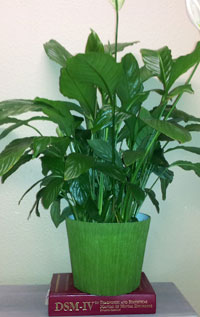 Celebrating a new office with a lavish plant. This is the best use of the DSM-IV — as a plant coaster!


 We learned a tremendous amount from our boss, clinical supervisor Vicki Wedegaertner, and the SPC Program Manger, Melissa Fike. Their knowledge and compassion set a very high standard and an inspiring model to emulate. Topics included communication, building resilience, stress, depression, anxiety, burn-out, legal reporting requirement for elder abuse, county resources, and more.