Seventeen year old Theo Baker, a freshman at Stanford, got a tip about data falsification in the research papers of the president of the university. He followed-up relentlessly and scrupulously, publishing an exposé of image manipulation in scientific articles that forced the president’s resignation.
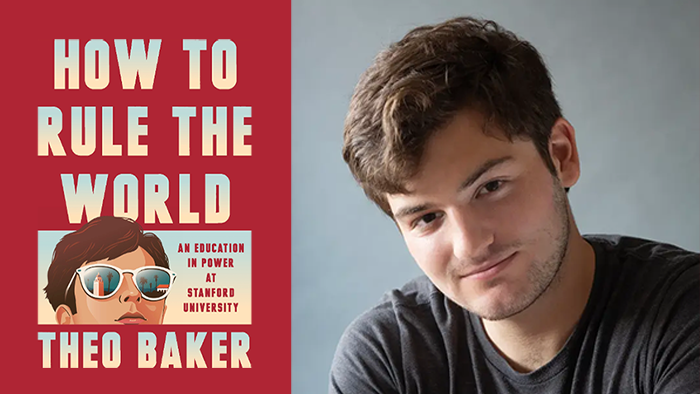
I read the book because I liked the writing in an Opinion piece in the NYTimes. I did not realize that it was a thinly-veiled promotion for the newly-published book, written by the son on the NYTimes Chief White House Correspondent, Peter Baker.
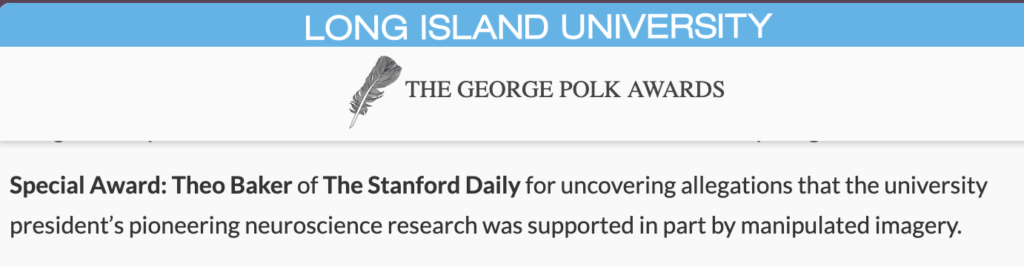
Theo was awarded a Special Polk Award in Journalism in 2022, based on his preliminary articles. In the book he recalls his happiest moment — when a member of the committee whispered to him, “We selected you even before we knew who your parents were.”
Having worked in University administration, I understand the hotbed of politics and agree with Henry Kissenger, quoted in Theo’s book:
University politics are vicious precisely because the stakes are so small.
Because we know the outcome — the president is forced out and Theo graduates on-time — the book is a thriller. I loved the writing in the first three-quarters of the book, but the end bogs down into legal jousting.
It stands out that Theo is brilliant and unrelenting. I see why his parents are proud of him and why it rang the chimes of the Long Island University committee that bestows Polk awards. Theo tells us about the “Stanford within Stanford” and the mind-boggling amount of money sloshing around young coders. But I question whether Theo could understand the consequences of his actions.
I watched the Commonwealth Club’s interview of Theo, and he used the word “chutzpah” to describe his effort. I agree that it’s the job of a college freshman to see how far his talent and perseverance will take him. It is part of learning who he is, and how he fits into the community around him.
People under 25 cannot calculate the consequences of actions
College educators understand that the best students are eager and motivated, but directing their energy is crucial because the prefrontal cortex and its connected decision-making networks undergo a massive rewiring process during adolescence that is not fully finished until a person reaches their mid-to-late 20s. These structures are:
- Prefrontal Cortex (PFC): The primary brain region for weighing potential outcomes, projecting future scenarios, and linking consequences to current activities.
- Anterior Cingulate Cortex (ACC): This region directly mediates model-based decision-making by evaluating risks, monitoring whether outcomes match predictions, and predicting what will happen if you choose one action over another.
- Orbitofrontal Cortex (OFC): A specific sub-region located just behind the eyes, critical for evaluating potential rewards and punishments before you act.
- Striatum: A deep brain area involved in evaluating risks, calculating potential payoffs, and updating your strategy when an outcome differs from what you expected
My questions are:
- What did Theo learn? That you get rewarded when you take away someone’s job?
- How did the university benefit from having to replace the president at a “seven figure cost”?
- What did Theo learn about kindness? Or the consequences of actions?
In the interview, Theo admitted that he experienced hostility and exclusion in his subsequent college years. On page 318 he says he was “attacked as a leftist hack in the opinion pages of The Wall Street Journal… By spring of my sophomore year, I couldn’t leave my dorm room without being harassed. I received numerous death threats, had events canceled over nebulous “security concerns,” and eventually had to leave campus altogether.”
He acknowledged in the Commonwealth Club interview that the book has been optioned by Hollywood and in the book he thanks Amy Pascal and his agents at CAA.
What did this kid learn?