The Secret of Our Success: How Culture Is Driving Human Evolution, Domesticating Our Species, and Making Us Smarter was recommended by Nicky Case The Evolution of Trust which I referenced near the end of my review of Beth Macy’s book Paper Girl. I especially loved this book because it has a chapter title: Prestige, Dominance, and Menopause.
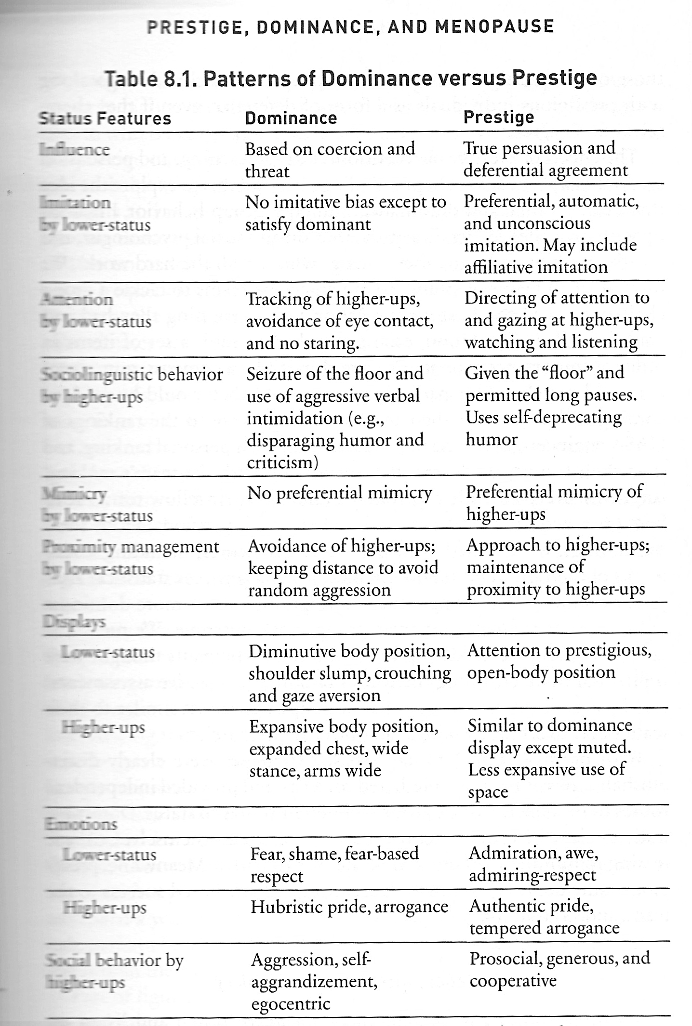
On page 127 the author defines Hubristic pride, which he calls Dominance, as seeking high status by controlling others through force or threat of force. Dominators physically tend to stand upright, expand the body and broaden the chest and widely spread their limbs to take up a lot of space. They tend to lower their voices over the course of an interaction. Their subordinates try to “look small” by shrinking their bodies, casting their eyes down, crouching their posture, and minimizing their presence to avoid random acts of aggression. Submissive displays are associated with the emotion of shame.
In contrast, Prestige is associated with the authentic pride that goes with seeking high status by gaining the admiration of others through one’s competence, skill, success, or know-how in valued domains. Leaders tend to tilt their heads up, have an open-body posture and smile. Lower-status individuals tend to gather around and to defer. Their emotions are admiration, awe, and respect that is not based on fear.
The menopause part of chapter 8 refers to elephants where the old matriarchs remember where the distant water holes are, and killer whale grandmothers who teach adolescent orcas how to beach themselves to gulp down seal pups, then how get back into the water. He suggests humans no longer respect the elderly because old humans become quickly obsolete due to rapid technological advances. Your grandmother can’t help you write a good profile for a dating app or counsel you on crypto investments.
 Henrich tracks the evolution of genetics and biology are weaves examples of cultural evolution to demonstrate how language and sociality launched our species on an extraordinary evolutionary trajectory. Several parts stood out for me. On page 188 he describes how, in a small society, one’s reputation provides a shield that protects them from harm or exploitation by others. Repeatedly violating social norms creates an opening for the violator to be exploited with relative impunity. I see this happening with my disabled veteran brother who is wheelchair-bound and living in relative isolation in Virginia. Because he is so difficult socially, he becomes a target for social predators.
Henrich describes shame in a social environment on page 198 as “Shame emerges when someone violates a social norm or delivers a substandard performance.” Violators or social norms display shame to communicate their acceptance of the local social order. It is saying, “Yes, I know I violated a norm and should be admonished for it, but please don’t be too harsh on me.” This would be the contracted posture described in the chart above.
Tasmania
Tasmania is roughly four-fifths the size of Ireland was once connected to Australia by a land bridge. The land bridge flooded about 12,000 years ago, creating the Bass Strait which separates Tasmania from what is now Melbourne, Victoria, Australia, by about 200 kilometers (about 120 miles). On page 220 Henrich describes the late 1700’s when the first Europeans arrived and they discovered a population of hunter-gatherers equipped with a simple toolkit of about 24 items. To hunt and fish, men used only a one-piece spear, rocks and throwing clubs. They had leaky rafts but no paddles. To ford a river, the women would push the raft across, towing their husbands and children. They did not catch or eat fish, and they drank from skulls.
Across the Bass Strait, Australian Aborigines possessed hundreds of additional specialized bone tools, boomerangs, nets for birds, fish, wallabies, sewn-bark canoes with paddles and wooden drinking bowls. Joseph Henrich theorized that the loss of rich social connections led to the shrinking of the Tasmanian’s collective brain. I found this fascinating in the context of the Talbots of Ireland who were granted the lands and harbour of Malahide in 1184 for services to King Henry II of England. The Talbots added to their holdings in 1821 when they acquired 3000 acres in Tasmania where they started a sheep station that they also named Malahide.
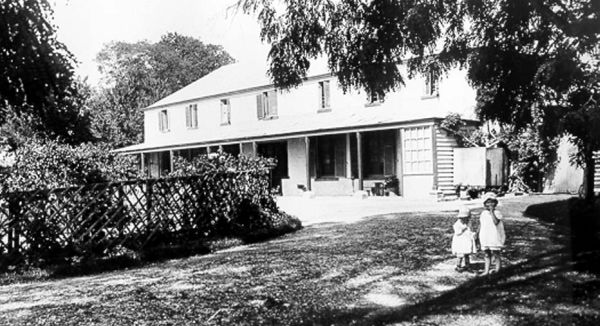
Malahide, Fingal Tasmania in 1899
The Tasmanian National Trust website “Unshackled” reports that 75,000 convicts were transported from Dublin’s Kilmainham Gaol to Tasmania between 1803 and 1853. In the year 1821, the same year the Talbots acquired the 3000 acres, the Hobart Prison Barracks were constructed in Tasmania to house the arriving convicts under sentence. “After 1821, all male convicts were processed at the Hobart Prison Barracks before being assigned labour roles across the island.”