Tag Archives: PTSD

“Paper Girl” Trauma Feedback Loop

“Paper Girl” Trauma Feedback Loop

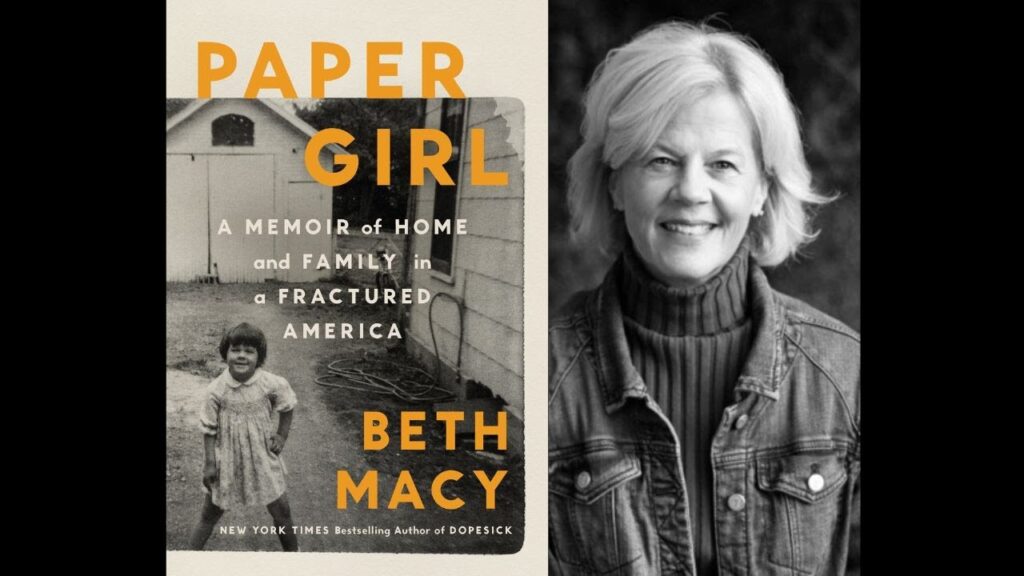
This “Memoir of Home and Family in a Fractured America” is at the top of Obama’s list of recommended books. I thought it would help me understand why a majority of Americans in 2024 voted for a lying, thieving, unfaithful criminal.
Beth Macy grew up in Urbana, Ohio and left in the mid-1980s to became a journalist. Not surprisingly, she blames the loss of local newspapers as an underlying reason for the loss of pride-of-place. The solutions she offers are well-meaning but shallow.

The book describes the implosion of the middle-class way of life in her hometown: manufacturing jobs moving overseas, technology replacing manual and low-level white collar jobs, and the decline of labor unions. She clarified how the Civil Rights law was used to force Blacks into the labor unions, creating race tensions that were deliberately inflamed to weaken the union.

The middle class was further eroded by “the fact that government stopped thinking of higher education as a public good and basically privatized it to the tune of $1.75 trillion in individual student debt.” Author Macy emphasizes that her pathway out of poverty was paved by the Pell Grant that sent her to college. Government stopped adequate funding of Pell Grants as Neoliberalism shifted priorities from “the common good” to “shareholder value.” She quotes philosopher Richard Rorty who predicted in 1998 that globalization and growing inequality would eventually lead to widespread class resentment and, eventually to fascism:

      Members of labor unions and unorganized unskilled workers will sooner or later realize that their government is not even trying to prevent wages from sinking or to prevent jobs from being exported. Around the same time, they will realize that suburban white-collar workers — themselves, desperately afraid of being downsized — are not going to let them selves be taxed to provide social benefits for anyone else.
      At that point, something will crack. The nonsuburban electorate will decide that the system has failed and start looking around for a strongman to vote for — someone willing to assure them that, once he is elected, the smug bureaucrats, tricky lawyers, overpaid bond salesmen, and postmodernist professors will no longer be calling the shots…
      One thing that is very likely to happen is that the gains made in the past forty years by black and brown Americans, and by homosexuals, will be wiped out. Jocular contempt for women will come back into fashion…. All the resentment which badly educated Americans feel about having their manners dictated to them by college graduates will find an outlet.”

Arlie Russell Hochschild’s 2024 book “Stolen Pride” is referenced, pointing to a pride paradox where the shared working class value of self-sufficiency gets twisted into self-blame for the betrayal by “the market” of Neoliberalism. “Doubly blocked [by corporations and government policy], they become vulnerable to structural shame,” and more apt to embrace authoritarians, the radical right, and the notion that it’s okay to convert their shame to blame — of gays, immigrants, people of color, and liberals.”

It isn’t until the end of the book that the reader discovers that both of the author’s children are queer (her word) and one of them is transgender, revealing her anguish at the imminent loss of their fragile safety and social acceptance. She brings us into the world of Travis, a high school aged girl-to-boy transsexual. On page 111, counseling professor Tania Israel wondered if one of the reasons Beth Macy wrote the book was, “Maybe you just want your son to be loved, ya know?”

Another focus is her niece Liza who was trapped in a household with her sexually abusive step father and she could not get help from her mother, her pastor, or the police. The book does a good job of (1) showing how deep the hole is for people like Travis and Liza and (2) the blindness of the HAVES to the children of people who are violent, addicted, and under-educated.


Rigid thinking is a trauma response

Nikki King, the addiction scholar, is quoted on page 302, “Rigid thinking is a trauma response.” Trauma alters how the nervous system detects and prioritizes safety and danger. In an environment of diminishing opportunity and fading hope, a self-reinforcing loop organizes around protection rather than connection, narrowing perception and limiting available responses.

In a place like Urbana, where so many are stuck in minimum-wage jobs and burdened by families that need more than is available, people are surrounded by anger, resentment, and despair. As the demands for time and money increase, the nervous system organizes around protecting themselves from further demands rather than connecting to the people who are asking for attention, time, and money. To defend themselves from the onslaught of demands, a person’s perception tends to narrow to the easiest response. Creeping despair limits resourcefulness. The energy erodes for a range of useful emotional responses. The emotionally exhausted and financially-depleted person rattles into a rut of rage against easy targets, echoed by the people in their social silo.
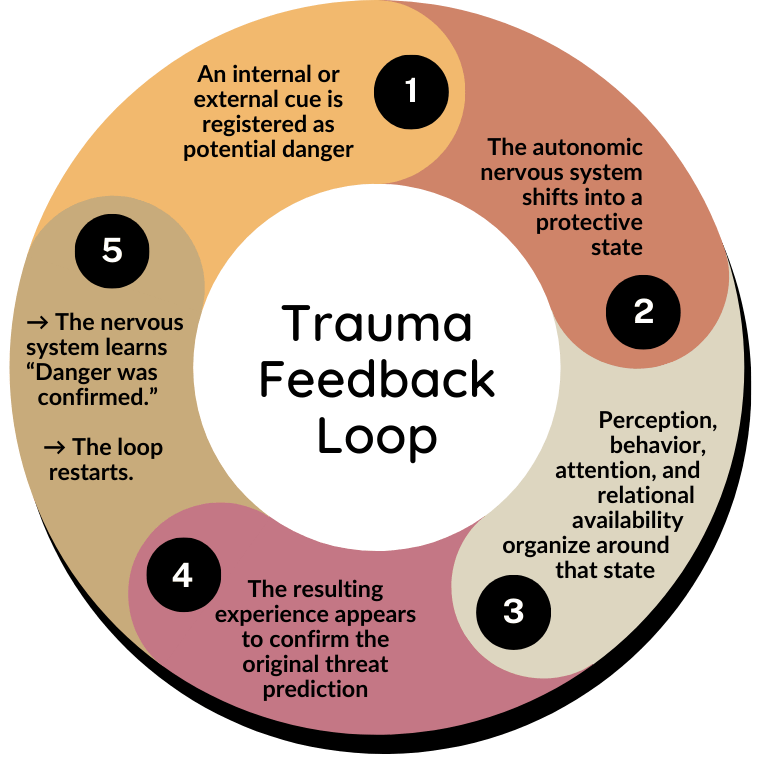
Trauma Feedback Loop – How We Get Trapped in “Silos” of GroupThink

Survival strategies become habitual, predictable, persistent, and
costly: physically, emotionally, and financially. People get stuck.


How to Escape the Trauma Feedback Loop

Resolving the problem of angry, resentful voters in places like Urbana requires many simultaneous approaches. Among them are

  1. Making the effort to get out of the Trauma Feedback loop,
  2. Improving access to more helpful news media and social media
  3. Making education affordable and accessible including funding for transportation

The three simultaneous efforts to unpeel the Trauma Feedback loop are:

  1. Learning to feel something other than rage. Becoming curious-not-furious
  2. When activated, and making the effort to be curious-not-furious, ask yourself, “What story am I telling myself? What memory is this triggering? What am I predicting?”
  3. Know how to calm your activated body enough to be able to make a rational choice about what to do. To be able to chose to RESPOND WITH INTEGRITY, prioritizing building families on a foundation of trust, and prioritizing trust in close relationships. Choosing not to lash out like a sleep-deprived toddler, or sulk like a teenager on junk food. Choosing instead to act like an adult with a fully-developed brain that can calculate the consequences of actions.

Calculating the Consequences of Actions

Is this a reasonable request, to expect full-grown people to engage their whole brains and take that nano-second to shape a useful RESPONSE rather than to react like a four year old on a sugar high? Studies on soldiers returning with PTSD show us that traumatized adults do not make rational decisions — they have emotional reactions. The Trauma Feedback Loop shows how this reactive behavior is self-reinforcing.

People trapped in the Trauma Feedback Loop display chronic hypervigilance, often ping-ponging between (1) emotional shutdown, withdrawal, and stonewalling and (2) anger, even rage, directed at the people closest to them or toward scapegoats like “woke” people. Research shows that even when traumatized adults have insight to their PTSD and make the intention to be more rational in their responses, ongoing physiological dysregulation hijacks that effort. The body always wins. When the nervous system is triggered, it will protect. The brain is designed for survival, not for singing Kumbaya.

For these adults economically trapped and traumatized by feeling helpless, this destructive behavior is not a failure of motivation, awareness, or effort —- it is a nervous system doing exactly what it is designed to do: to survive. The threatened brain does not pause to calculate the consequences of actions. This calculation of consequences is limited to people who feel relatively safe and relatively calm.

How to Interrupt the Loop

In order to learn, people need to feel relatively safe and relatively calm. The challenge is to create an atmosphere of trust to foster a physiological change inside the nervous system, in real time, by:

  • Identifying early nervous system shifts before defensive reactions fully mobilize
  • Tracking what is triggering the reactions at the level of bodily neuroception
  • Slowing or interrupting defensive momentum without overriding safety
  • Expanding access to a broader range of physiological and relational responses
  • Supporting the nervous system in updating safety through lived experience — not explanation.

“Updating through lived experience” is also called “learning,” but people need to feel safe and calm to begin to remodel the nervous system. An atmosphere of trust works best.

When people stuck in the trauma feedback loop can reorganize their nervous systems enough so that their responses are usually kind and thoughtful, they regain trusting access to their families, curiosity about the people and world around them, a sense of agency both economically and socially, and emotional availability without getting hijacked back to the lash-out-numb-out survival reaction.

Banking, Business and Society are Built on Trust

1950s man in Fedora

When America was Great?

While I have talked a lot about safety, I believe the real issue is trust. Would you go to work if you did not believe that you would get a check on payday?

I think a deep layer of rage is toward the betrayal of the “promise” after WWII that Americans who worked hard would be able to have the American Dream of a house and life better than their parents. If there were still good factory jobs and only three television networks, would we have the bifurcated communications environment of today? What went wrong?

Broadly, two things (1) undoing Glass-Steagall and (2) changing the law to require “maximizing shareholder value.”

After the stock market crash of 1929, banking and finance was reformed by New Deal reforms such as the Glass-Steagall Act which separated commercial and investment banking. Never again would the wealthy and powerful play monopoly with regular people’s money. Lloyd Blankfein refers to this in a recent interview.

Laws passed by Congress were undermined in the courts, as described in the book The Quiet Coup. Prior to that, most companies included employee and community welfare in their planning and actions. Neoliberalism was the fancy word for the greed that took hold again under Ronald Reagan during the 1980s under the guise of “smaller government, lower taxes, less regulation.” Academics like Milton Friedman and economists like Alan Greenspan jumped on the bandwagon and many Democrats followed suit creating the conditions we see in Urbana now. NAFTA was negotiated by President George H.W. Bush and signed into law by Bill Clinton, who further deregulated banking and finance.

Some people think that hitting rock bottom again, as we did in 1929, will wise Americans up and we will begin to create “new” New Deal. Conversely, maybe economically disadvantaged Americans will fall further into fascism. What I wonder is: when the middle-class “knowledge workers” suddenly lose their jobs to A.I. and they are forced into the some economic trauma as the working class of Urbana, will they too become reactionary fascists?

Corporations are creations of the law and Mehrsa Baradaran says we need to change the laws so these creations have responsibilities to the society that makes their profits possible. The gospel of “shareholder value” only reaped great rewards for those companies with a single or small number of major or exclusive shareholders.

For the most part, widely held companies were either driven out of business — so the valuable parts could be acquired — or bought up in leveraged buyouts to be broken up and sold by the “Barbarians at the Gate.”

The Evolution of Trust

Nicky Case created a 30-minute game that uses Game Theory and the Prisoner’s Dilemma to play out the probabilities of The Evolution of Trust.

Fascinating and insightful, it sets the groundwork for another prediction game that demonstrates why communities like Urbana, built by immigrants, become so hostile to new immigrants.

YouTube channel Veritasium (the element of truth) riffed off the graphics created by Nicky Case to explore the question “Can you really reach anyone in six steps?” The figures in green represent TRUSTED people. Think of them as people in Urbana. Reds are distrusted, let’s say new immigrants to Urbana.

In the leftmost image with three green trusted Urbana residents at the top, imagine they are all connected by the simple garland, no shorcuts. Trust grows organically at the edges — people come to trust those with whom they have repeated good interactions. Add the shortcuts of green-to-red and red-to-red and the system quickly becomes all red. Trust disappears from the system, the cooperators were crushed.
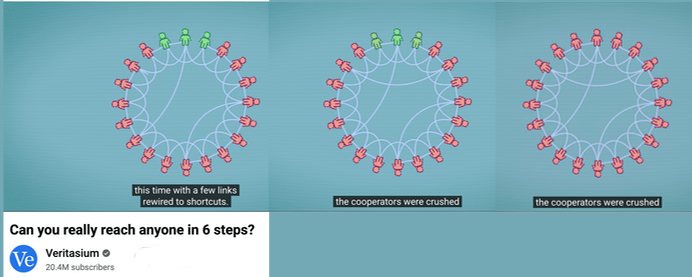
Click for YouTube Veritasium Video

As trust erodes in our communities, our financial systems and society itself is undermined. I think the answer is to restore trust in ourselves, our families, our neighbors, our communities, and our citizenship. This has to be done on a one-to-one basis. We need to learn how to build trust with people who are not like us. We need to step out of our media echo chambers.

The Author’s Solution

On page 301, Beth Macy outlines her solutions:

  • strengthen public schools,
  • invigorate “real life with other human beings including those we don’t know,”
  • support local news,
  • run for local office and/or support candidates who are trying to change things for the better for most people.

My solution is less glib. The middle class resents paying taxes to support the jobless, blind to their own impending slide into joblessness via A.I. displacement. Life is not a football game. It is time to shift from us-versus-them thinking and to do the hard work of finding and executing win-win strategies. Stop wasting energy by protesting the Rich. The Rich will always be with us. In a democracy, we bear the load we can. We are all in this together. No one gets out alive, so pitch in and connect. Create ways to make things better for most people. Find a way to make the best of what we have. Share the wealth. Get smart and consider strategic forgiveness in what Nicky Case calls the Copykitten way of getting ahead while creating community.
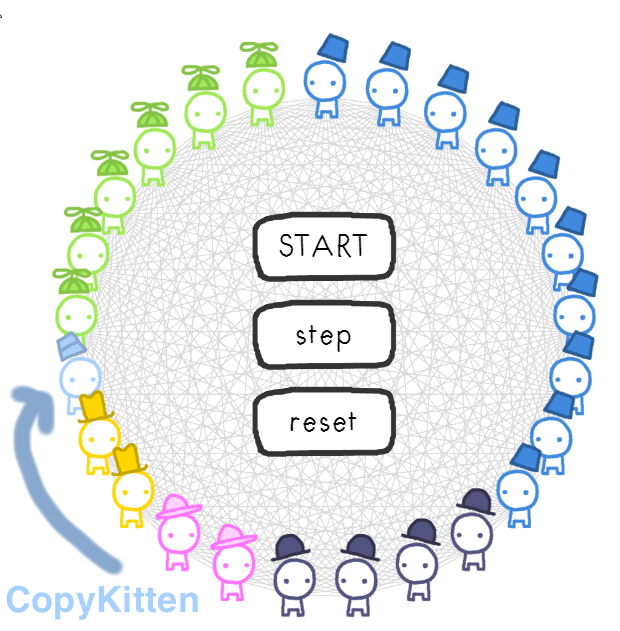
screenshot from Evolution of Trust Game

Click Image for Evolution of Trust Game by Nicky Case
Kristin Hannah – “The Women”

Kristin Hannah – “The Women”

My sister Mary Rose recommended “The Women” and commented,”When I chat with women who have read it, they’ve each mentioned something different that struck them deeply — none of which was the thing that struck me. Veddy interesting. Rye was the horrid bad guy in the whole story, in my opinion.
“You could be a hero,” he says to an impressionable young Frankie. Grrr. Those stupid words provoked her bravado so that she could impress her dad and have a place on his office wall.
Well, that certainly backfired.”

I agree that Rye, the lying cheat, was the horrid bad guy in the story. And the book blames Rye for Frankie’s decision to try to be a hero and get on her father’s “Wall of Honor.” I think it is interesting that the writer chose to make the father Irish-born, and wrote the mother as someone struggling with alcohol for years.

I read many first-person nurse stories when I was preparing my China Beach spec script. This book was written by a younger woman who created a composite Frankie. From my point-of-view, Frankie was already a “hero child” growing up with an incapacitated mother whom she would rescue, and an emotionally-distant father who harbored contempt for females. Frankie’s love of feeling “competent and needed” prompted her decision to re-up as her first tour was coming to an end. She had finally started to feel skillful and valued.

Part of PTSD is the loss of ability to feel connected to people who love you, well-described in Frankie’s relationship with Dr. Acevedo when she returned to Coronado. Dr. Acevedo did not need her. Rye “needed” her. That was the hook he had, that kept her coming back even when it was contrary to her values. That was the slippery slope that sent her into self-destructive addiction. Giving up herself, in order to feel needed.

The writer had to paint some reason for Frankie to want to be a hero so she pinned it on Rye, the lying cheat. But in real life, there are children who learn to survive by becoming the hero in the family. The kid who does the work that the impaired parents can’t do, the kid who gets attention only for what she does. No love for simply being a kid. To be valued, she has to turn into a little adult. A “parentalized child.” A hero, who is safe only when she is competent and needed.

Felt Sense Polyvagal Model Course

Felt Sense Polyvagal Model Course

FSPM Certificate of Completion

It took six months and more than $1000 to earn the FSPM Completion Certificate (and an additional Focusing.org certification that I am professionally-trained in Focusing) and I learned a LOT. The course tuition was a gift from my brother Tim (thanks, Tim).

In 1985 I bought my first copy of “Focusing” by Gene Gendlin, Ph.D. on the recommendation of a Buddhist nun teaching a course at Point Reyes that was part of my shift from selling TV time to writing full time. I tried to focus by myself, and I read the book many times, but I never got real traction with focusing.

I ordered Jan Winhall’s book before it was even published and realized that it precisely targeted the kind of treatment I needed. I joined the third cohort of her FSPM class taught online through the Polyvagal Institute. Some of what I learned:

  • PTSD can be broken into two main categories. First: what happens to adults, such as on the battlefield or after an assault or car crash.
  • Second: what happens to children. Calling it by the same name as adult Shell Shock is not good medicine.
  • PTSD is usually thought of as physical threat, and this kind of trauma is associated with the fear of being killed.
  • Moral Injury is a different type of PTSD and also occurs in the context of war but requires different treatment. Here is the Veteran’s website on the issue.
  • Traumatic events can be public, like war; private, like the death of a parent or the loss of a platoon member; or secret, like child sexual abuse or being commanded to murder a bound prisoner.
  • Healing secret moral injury requires more than acknowledging it. Some events require an actual sense of being forgiven.

The FSPM class added several very powerful elements to the classic Gendlin model.

  • Actually focusing with another person revealed what Gendlin calls “the power of human presence” which seemed to create a kind of “force field” that kept me from wiggling out of looking at what was coming up to be seen.
  • The focusing practice required reciprocity with the focusing partner. Bessel Van der Kolk describes childhood PTSD as “a failure of interpersonal safety and reciprocity.” This practice consciously addresses both issues in the context of an ongoing, mutually-beneficial relationship.
  • The course trained us to create images using “bodycards” using non-verbal ways to express the sensations, feelings, memories and thoughts that came up during the focusing session. This non-verbal process was crucial in shifting me out of linear thinking. It drew me into somatic ways of connecting with my body.
  • We were required to complete at least 15 Process Recordings over the six months. To me, this is the Secret Sauce of the FSPM training. The Process Recording of the focusing session is only a few sentences, maybe a paragraph, and includes the image of the bodycard or other image from the session.
  • Actually, the Secret Sauce was that the Process Recordings went directly to Jan Winhall who personally replied to them, often within minutes. The felt sense of being witnessed by a therapist of Jan’s caliber gave me a tremendous sense of being seen, finally, by a kind adult who offered “unconditional positive regard” as Carl Rogers would say. This supplied the missing puzzle-piece that seemed to have been broken off my nervous system by the years of unrelenting punishment and degradation from which I could not escape.

The Process Recording could take an hour or more for me to prepare even though the report itself was just a few sentences. As I approached the fifth of the 15 required sessions, I began using my phone to record the last 10 minutes of what I said out loud, as well as making hand-written notes during the session, sometimes of things I did not say out loud. I would review the recording and sometimes I would transcribe the entire 10 minutes as a way to re-experience what came up. Some of the drawings I made were images of my relationship with my bad mother, or with parts of myself, or a visualization of a transformation.

Several times, I wrote out a script and recorded it on my phone for my own use, combining the revelations of the focusing session with other insights from the Paul Linden aikido-based Being-In-Movement classes, the John F. Barnes myofascial release practices and readings, and a Teal Swan Completion Process course. I would listen to my recordings when I couldn’t sleep at night. I became willing to be much more in contact with the information and messages from my body.

I am grateful for the course. I learned a lot and I feel hopeful about becoming fully present, 100% regulated, my true self.

Veterans Affairs site for Moral Injury.

Irene Lyon: Who Heals?

Irene Lyon: Who Heals?

Irene Lyon says that, ideally, we develop a sense of safety and belonging within our bones, guts, and cells as our attuned caregivers encourage us to feel self-worth and personal agency over the pivotal first three years of our lives. Because we are too young to think and reason, our learning is stored into our body posture and the muscles that move us, the muscles that give us strength and a felt-sense of confidence to take on the world.

Father son attunement

Photo taken by Mother

The sensation that we are worthy of the effort it takes to get what we want comes up from our gut which sends more signals to the brain than the brain does down to the gut. As we grow up, we become conscious of our thoughts which get laser-beamed down to the gut, reinforcing the feeling that we can cope with the challenges of our life.

Vagus Nerve

Afferent Signals Arrive in the Brain

Calm is not the same as Regulated – PVI Oct. 2023

The energy that forms how we sense our gut and organ systems (what we call our Sixth Sense) defines our sensations of ourselves as physical, emotional, mental, relational and creative beings. When we are unable to connect to ourselves, to others and our to environment, this shut-down behavior is often described as PTSD. How did this connection get faulty?

For some of us, it goes back for generations, including how our parents were raised and how they mirrored this behavior in our early years. Where large broods are the norm and poverty is widespread, babies were often seen as “yet another mouth to feed” rather than an opportunity to build something wonderful for the next generation. Beating children and chronic shaming practices that use disconnection (get out of the car, now!) and humiliation as a way to control a child’s behavior creates a high level of toxic stress and biological shame that becomes infused into the ENTIRE organism of the young child. In very young children, these feelings are learned as body sensations, which can’t be rationalized later as words or stories. These bad feelings must be addressed where they are: in the body and nervous system.

Those of us who experienced this kind of toxic shaming in infancy and childhood don’t know what it means to feel safe and relaxed in our bones, gut, and cells. We have learned to always be on guard and to express something along the lines of

“all connection is bad and everyone is to be suspected as dangerous and a threat.”

The chronic betrayal by parents and primary caregivers, from which an infant or toddler cannot escape, can instill a quality of hopelessness and defeat such that the person, as an adult, will feel they are in fact bad meat. This underlies self-harm and addictions. The internalized belief that they don’t deserve to be treated well (as the adult may have screamed while the beating the child) leads them to risky situations and abusive relationships. The pervading sense that they are not valued, or even wanted, can lead to a constant cycle of resistance to doing the work, fleeing from healthy behaviors, and rejecting the care of healers and supportive situations. See Irene Lyon‘s blogpost on why every trauma survivor CAN heal, but not everyone will.

For those of us who had mothers who were not capable of soothing us, we lived our early lives ping-ponging between hypervigilant and freeze response. We must learn what it feels like to be biologically calm and to cultivate an internal sense of safety and connectedness. So much restoration work is required, including realizing that maybe the mother herself never felt safe or calm. Coming to accept that my mother could not soothe me, even though I was capable of being soothed by my godmother, allowed me to forgive both my mother and myself. I see now that maybe I am good seed that fell upon rocky ground.

Oprah says, “Feeling that you deserve something is not the same thing as feeling worthy.” And simply feeling deserving and worthy doesn’t mean there isn’t a Competing Commitment such as “if I become biologically calm, I won’t be on the same wavelength as my family and they will reject me because they believe that I must be like them to be liked by them.” If someone has a (maybe unconscious) belief that getting well would betray their connection to their (birth) family, they might get trapped on the hamster wheel of spiritual seeking. See this Harvard Business Review article titled The Real Reason People Won’t Change.

Update Dec 2021

NYTimes Opinion “Opioids Feel Like Love”

The connections between brain opioids and motherly love were first explored by the neuroscientist Jaak Panksepp decades ago. Dr. Panksepp, who died in 2017, told me that when he first tried to publish data connecting brain opioids to attachment, he was rebuffed by a top medical journal. His research showed that morphine, in doses so low that it didn’t cause sleepiness, eased separation cries made by baby animals in multiple species.

The idea that the purest, most innocent love — between parent and child — could have any commonalities with the degradation of heroin addiction was “too hot to handle,” Dr. Panksepp told me. Today, however, decades after he published his work in another journal, what is now known as the “brain opioid theory of social attachment” is widely accepted.

When people nurture children or fall in love, hormones like oxytocin are released, infusing memories of being together with endorphin-mediated feelings of calm, contentment and satisfaction. This is one way that social contact relieves stress, making bonding a fundamental protector of both mental and physical health. When we are far from our loved ones or sense that our relationships are threatened, we feel an anxiety that is not unlike withdrawal from drugs.

So if “all connection is bad and everyone is to be suspected as dangerous and a threat,” the endorphins and oxytocin are not endogenously generated. Attachment does not become pleasurable or soothing. Spending time with others does not produce “calm, contentment and satisfaction.” No wonder Maia Szalavitz says “Addiction is A Learning Disorder.”

Update October 2023

BOTSA PDF link updated Brain Opioid Theory of Attachment. The endogenous opioid system plays a central role in sociality in primates, including humans. Conclusion:

We conclude that there is significant evidence for a role for the endorphin system in a range of mammalian bonding behaviours, including separation distress, play, gregariousness, grooming, infant attachment behaviours, positive affect and affiliative behaviours.

It goes on to say that emotional pain is reduced not only by endogenous opioids but also by oxyctocin, so maybe a caring kiss really does soften the pain. Reducing emotional pain using opioids, endogenous or not, flattens all emotions, not just the painful ones.

Anterior Cingulate CortexEndogenous opiods ties in with pain management using self-hypnosis according to David Spiegel, MD, Associate Chair of Psychiatry & Behavioral Sciences at Stanford University and founder of Reveri self-hypnosis app. At about 40 minutes in to this podcast, he suggests that pain can be managed when self-hypnosis activates endogenous opioids in the dorsal portion of the anterior cingulate cortex (midline “default mode network” emotional regulation).

If you say, “Your hand’s in ice water, cold, tingling, and numb,” [an MRI shows that] you turn down activity in the somatosensory cortex here. If you say, “Well, the pain’s there, but it won’t bother you,” which is sort of the way people on opioids sometimes feel, it was in a different part of the brain, the dorsal anterior cingulate, which is a part of the brain that we’ve shown turns down activity when you go into hypnosis, so we understand how the brain is doing it.

Jan Winhall said, on October 5, 2023 in a PESI seminar, that trauma survivors can work to remove danger from their surroundings but that the numbing behavior, which was an adaptive coping strategy, sometimes continues and interferes with connection with the self and with others. She recommends shifting away from a pathologizing model of these adaptive behaviors and, when safe, to “turn down the dial” on endogenous opioid production so the person can titrate the willingness to tolerate emotional pain and “revivify” emotional attachment.

Facebook Hou-Dunnie

Facebook Hou-Dunnie

Jim DeRoche posted this on Facebook with the comment, “It’s not.”

My comment:

When I was a toddler, my parents used to tie me to the highchair in the kitchen, then go to the front room to play Bridge with their friends. I was so adept at getting free, their friends called me Hou-Dunnie.

His reply:

Anyone, who is incarcerated or held against their will in any manner, possessing the mental toughness and heart to stand against their circumstances, I have great respect for always. Anyone, who adds a 3-D component to the mental one, physically demonstrating where their heart is by successfully going over the wall in any manner and beating the opposition, I have even greater respect for always! Love that move you pulled, reversing your parents sketchy binding caper, defiantly executing a move superior to that perpetrated against yourself and winning the evening. That’s a keeper of a story! ?❤️?❤️?

Yeah, well I have 10 younger siblings, and I have more stories about bound toddlers. But… another day…

Anet Dunne Crack me the F up!

Boundaries: Excerpts

Boundaries: Excerpts

Anna Runkle, the Crappy Childhood Fairy, recommended Boundaries by Cloud & Townsend. At first, it was hard slogging through the ultra-Christian rhetoric and scriptural references, but it started to make sense by the end as an example of Judeo-Christian indoctrination in our society. Here are some excerpts. Brackets indicate my comments.

p87 – The Law of Cause and Effect. Rescuing a person from the natural consequences of his behavior ENABLES him to continue his irresponsible behavior.

p219 – Fear of Success. Poor finishers fear envy, criticism, [punishment and revenge]. [The #1 emotion of narcissists is envy.]

p223 – We withdraw from relationships when we need them most. Just like untreated cancer, boundary problems will worsen with isolation. [Co-regulation is stronger, more balanced.]

p227 – Unmet emotional hungers. We all need love during the first few years of life. If we don’t receive this love, we hunger for the rest of our lives. This hunger for love is so powerful that when we don’t find it in relationships with other people, we look for it in [things] food, work, sexual activity, or over-spending money. Compulsive spending is often a reaction against strict rules.

p229 – Address your real need. Impulsive eaters may discover that food is a way to stay separate and safe from romantic and sexual intimacy. As their internal boundaries with the opposite sex become firmer, they can give up their destructive food boundary. They learn to ask for help for the real problem, not just the symptom.

p231 – Surrounding yourself with people who are loving and supportive, but who will not rescue.

p234 – [Survivors of childhood trauma] are convinced there is no good within them. Over-permeable boundaries. Believe they are treated badly because that’s what they deserve. Our ability to trust ourselves is based on our experience of others as trustworthy.

Trust, the ability to depend on ourselves and others in time of need, is a basic spiritual and emotional survival need.

  • Figure out what you are risking when you change
  • Are you willing to lose (love, safety, …)
  • Be diligent in carrying out your plan
  • Get started. Do it.
  • Don’t give up. Pursue your plan to the finish.

Forgiveness is: writing off the debt in our hearts. They no longer “owe” us.
p259 – Take an inventory of your unmet needs.
p260 – To set boundaries is to risk losing the love you have craved for a long time. Letting go of the wish for them to be different is the essence of grief.

  1. Own the problem of your own poor boundaries.
  2. Stop sabotaging your freedom.
  3. Seek Grace and Truth to cope with grief
  4. Get support for your grief.
  5. Let go of what you can never have. Move on to what you want.

You can only steer a moving ship. Your efforts to preserve the old waste your energy and time. Letting go is the way to serenity. Grief is the path.

Coming from a home where anger was used by a parent to control children
p262 – Do I have an angry person in my head that I still fear? This hurt, frightened part needs to be soothed.

  1. Realize it is a problem
  2. Talk to someone. You will not not work this out alone.
  3. Find the source of your fear (Anna Runkle’s Daily Practice)
  4. Stick to self-control statements, stick to your decisions, reiterate what you will do and what you will NOT do. Let them be angry. Tell them you care for them but your NO still stands.
  5. Regroup and talk to your support system.
  6. Practice. “God does not want angry people to control me.”

Blaming others gives them to power to [be the only one who can] make things right. Take back your power by taking responsibility for your life and make the life you want.

Guilt is not a core emotion. It is “you are bad.” [It is a trauma response to a boundary violation suffered as a child.]
The guilt I feel is my problem. Do the things that are right but elicit guilt feelings [or fear of punishment/retaliation/retribution]. Work the edge. Cope with the grief. Mourn.

First, securely bond [with someone appropriate and capable of secure bonding]. Second, set boundaries.

Don’t ping-pong between Compliance and Isolation

Resentment is a signal. Do I have permission to feel angry? Anger is a messenger.
p279 – Boundary-injured people are slaves

Conception Explodes Off Channel Islands

Conception Explodes Off Channel Islands

I posted this comment to this NYTimes article California Boat Fire Kills at Least 20; Haunting Pleas as Flames Erupt

I spent two nights on the Conception with a Sierra Club trip to the channel islands in October 2017. It has a main stairway from the passenger bunks below deck to the kitchen on the main deck and also a secondary escape hatch which they made sure we knew about in the Emergency Procedure Drill they held. The hatch opened to the main deck cabin, which we all saw was engulfed in flames. I am also a diver and have slept on other boats and you are right, they are similar. Typically, the crew sleeps close to the wheel house, far from the passengers. I am stunned by this tragedy.

Channel Is Conception Explosion

Conception Boat Fire

The Conception at Daybreak

Conception Below Deck Floor Plan

The Secondary Escape Hatch Was Under The “N”

I have not yet written about the Sierra Club trip because it was shortly after the October 2017 fires in Santa Rosa. I had planned the Channel Islands trip months earlier, and paid for it in advance, as required, so I had to go. Frankly, I was grateful to get out of Santa Rosa even though I was coming down with a massive cold contracted in the shelters. But more on that later.

Trauma: Inherited, Denied, Healed

Trauma: Inherited, Denied, Healed

Elizabeth Rossner writes about the legacy of trauma and the labyrinth of memory in this wide-ranging review of her visits to Auschwitz with her father who came through the camps (she has a chapter on why she does not use the word “survivor” here). She also explores the legacy of trauma for the survivors and their children who experienced the killing fields of Cambodia, the retreat from Hanoi, and the massacre in Rwanda.

Traumatized people don’t feel safe, and parents who feel unsafe create households without a feeling safety, raising children do who not feel safe. The traumatized parents express the unresolved trauma in two main ways:
1. Suppressing all emotion in an effort to suppress the unrelenting, wordless fear trapped in the body. Children can’t play with someone who is numb. Children can’t bond well with someone who is numb. Drugs and alcohol often strengthen the numbness and emotional unavailability.
2. Traumatic rage squirting out uncontrollably in overreactions to upsetting everyday events. Children never know when the traumatized parent is going to beat them for a trivial infraction, or embrace them with understanding. The parent is inconsistent, and blind to the inconsistency.

Rossner quotes Dr. Maria Angeles Morcuenda, “The children of people with unresolved trauma have not learned [yet] to feel safe [even when they are] in a safe environment.”


Esther Perel says “home is the place where you feel safe, seen, appreciated, respected, and wanted.” When trauma in the home is denied, such as physical abuse, emotional abuse (betrayal and the like), or sexual abuse, the dependent child may resort to denial in order to preserve the attachment on the damaged parent upon whom she or she relies.

“Trauma denial is an act of self-preservation,” says Perel. “We employ self-delusion when too much is at stake and we have too much to lose. The mind needs coherence, so it disposes of the inconsistencies (lies) that threaten the structure of our lives. This becomes more pronounced when we are betrayed by those we feel closest to.”

Elizabeth Rossner says, “I hope my book invites readers to consider their own relationship to intergenerational transmutations of grief, trauma and resilience.” In her conversations with Dr. Morcuenda, we learn that healing from trauma is all about getting to feel safe. Dr. Morcuenda’s work focuses on “How do we make this baby, this child, resilient to the inevitable trauma life is going to bring? The work is to give each child what he or she needs, and to recognize what interferes with their ability to do that.”

Healing is seen when the trauma survivor can become fully present in the moment. Resilience can develop when we can interact fully in the moment without numbing out or slipping into the past.

My Absolute Darling

My Absolute Darling

I read Gabriel Tallent’s book straight through in two days in August. Then I saw the blurb from Stephen King who offered an unsolicited endorsement. “I tore through an advance copy of the 400-plus-page novel in three days. It’s a first novel and he’s got everything working,” Mr. King said. “When I read it the first thing I thought was, I couldn’t do this, and I’ve been doing it for 40 years.”

While it is technically a first novel, it took eight years to write, and Gabriel’s mother is fiction writer Elizabeth Tallent. According to the New York Times, “Mr. Tallent began writing the book during his senior year of college at Willamette University in Salem, Ore. After graduating, he got a job as a waiter at a ski lodge. On days he wasn’t working, he’d write for 12 to 14 hours.

“Three years later, he had 800 pages of a sprawling novel about the Pacific Northwest and the strange characters who live there. He realized the seed of a more arresting story was there, scrapped the draft and wrote a much different novel, one that focused on Turtle’s experience and the physical, psychological and sexual abuse she endures, and her fight to overcome it. It took him five more years and another dozen drafts to finish the book.”

The New York Times says, “Turtle’s story unfolds on the coast of Northern California, in the lush, untamed forests, gulches and tide pools around Mendocino. She lives with her paranoid, survivalist father — a self-taught philosopher and gun nut who teaches her that the world is a treacherous place and humanity is doomed. At 6, she learns how to fire a bolt-action pistol. At 14, she’s become an expert sharpshooter and hunter who can navigate the forests in the dark, identify edible plants, make fire with a bow drill and shoot, skin and roast a rabbit over a fire of dried grass and twigs. She’s at home in the wilderness, but is failing at school and estranged from her peers and teachers. She’s alone except for Martin, a sadistic monster who would sooner kill her than lose control over her.”

The intensity of the book captured me and took me to a place I thought no one else could ever see. It showed that intensity is not the same as connection. Thrill is not the same as pleasure. Arousal is not necessarily good. Excitement is addictive. The paragraph on p.338 that was most compelling for me:

Turtle thinks, pull the trigger. She can imagine no other way forward. She thinks, pull the trigger. But if you do not pull the trigger, walk back up that creek and in through the door and take possession of your mind, because your inaction is killing you. She sits looking out at the beach, and she thinks, I want to survive this. She is surprised by the depth and clarity of her desire. Her throat tightens and she takes the gun out of her mouth and strings of saliva come with it and she brushes them away. She rises and stands looking our at the waves, overcome with the beauty. Her whole mind feels raw and receptive. She experiences a searing, wide-open thankfulness, an unmediated wonder at the world.

The beauty of the Mendocino area is woven into emotional intensity and family violence in an extraordinary way. I agree with the top writers who declared the book a “masterpiece” on par with “Catch-22” and “To Kill a Mockingbird.”